

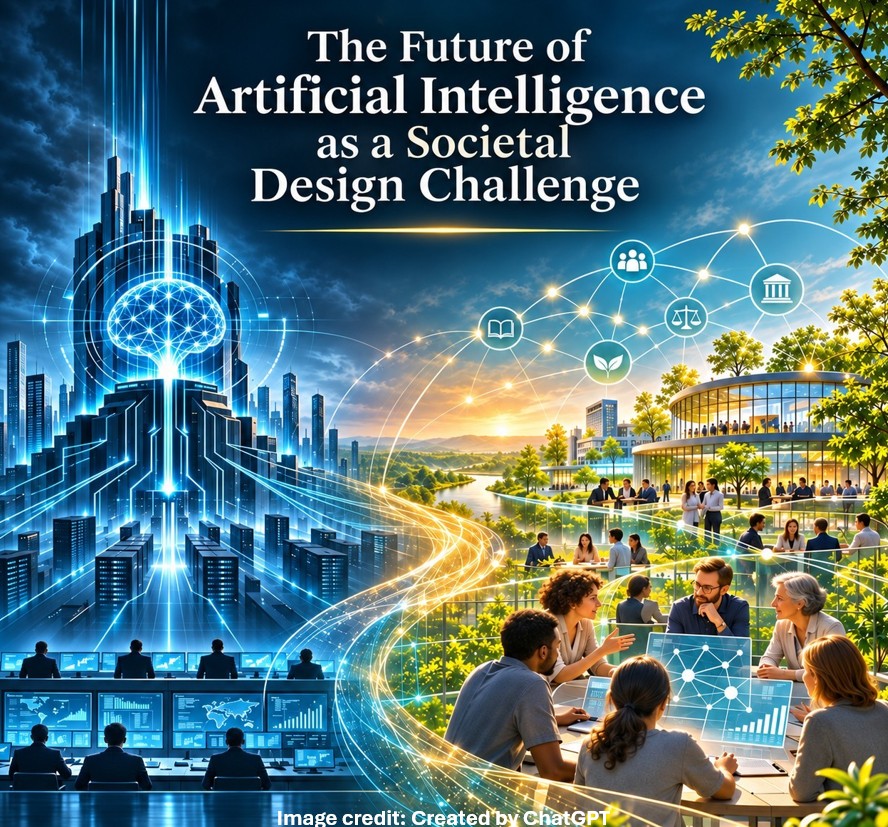
Where is artificial intelligence headed—toward a technocentric architecture of centralized artificial intelligence – or a sociotechnical architecture of collective intelligence?
A Preview of My New Book: From the BCM Model to Hybrid HCAI – Part III: Author: Friedrich R. Schieck, Published – November 2026
ABSTRACT
The future of artificial intelligence is not merely a technological challenge, but a fundamental economic, organizational, and sociopolitical task of shaping the future. This article examines two ideal-typical development paradigms: a technocentric architecture of centralized artificial intelligence and a human-centered, socio-technical architecture of collective intelligence. Based on five interconnected systemic challenges—the productivity and investment paradox, the displacement of human labor and the loss of expertise, the concentration of economic and technological power, the erosion of the information and trust order, and the potential loss of control over autonomous AI agents—the necessity of a fundamental paradigm shift is discussed.
Based on BCM and Hybrid-HCAI, an interdisciplinary research and development framework is proposed that integrates four central design dimensions: the information and knowledge architecture, the communication, interaction, and governance architecture, the human-centered and systemically embedded AI architecture, and the qualitative scalability of collective intelligence. These are to be scientifically specified and made verifiable through two complementary reference models—an integrative structural architecture model and a functional algorithmic coordination model.
A central thesis of this paper is that the development of such an architecture should itself be organized according to the principles of collective intelligence. To this end, the paper proposes the launch of an international, interdisciplinary, and—as far as possible—institutionally independent network platform that functions simultaneously as a research subject, a research tool, and an experimental prototype.
Through a recursive development and learning process, the prerequisites and effects of collective intelligence are to be systematically investigated, tested in practice, and continuously refined.
This paper is intended as a conceptual impetus for an interdisciplinary research program whose overarching goal is to design artificial intelligence to promote human autonomy, democratic self-determination, societal learning capacity, and responsible collaboration.
Keywords: Collective intelligence, human-centered AI, hybrid HCAI, BCM, socio-technical architecture, AI governance, qualitative scalability, algorithmic coordination, human autonomy, recursive development processes, democratic self-organization.
TABLE OF CONTENTS
- Introduction – Anthropic’s IPO and the Message from Dario and Daniela Amodei
- The Systemic Contradictions of Current AI Development
- Two Competing Development Paradigms of Artificial Intelligence
- My First Key Concern: The Development of a Socio-Technical Architecture of Collective Intelligence
- Four Interdisciplinary Fundamental Questions Regarding a Socio-Technical Architecture of Collective Intelligence
- From Fundamental Questions to Two Integrated Reference Models
- My Second Key Concern: Organizing the Development Process Itself According to the Principles of Collective Intelligence
- The Limits of Current Scientific and Societal Structures of Discussion
- An Interdisciplinary Network Platform as an Experimental Prototype of Collective Intelligence
- The Institutional and Economic Independence of Such a Platform
- A Recursive Development and Learning Process
- Where Are Such Interdisciplinary Development Processes Already Taking Place?
- Conclusion: Developing collective intelligence through collective intelligence.
1. INTRODUCTION – ANTHROPIC’S IPO AND THE MESSAGE FROM DARIO AND DANIELA AMODEI
On the occasion of Anthropic’s initial public offering on November 19, 2026, Dario Amodei and his sister Daniela Amodei issued a far-reaching message about the future of artificial intelligence and human society. In essence, it reads as follows:
Artificial intelligence could trigger the greatest scientific and economic upheaval in human history. Whether this leads to a better society or causes serious social harm depends largely on how people develop, control, and use this technology. [1]
Anthropic’s valuation reached between 1.3 and 1.7 trillion U.S. dollars at the close of trading. Particularly noteworthy is the total offering size, which includes an additional private placement of 107.3 billion U.S. dollars. [2]
These colossal sums illustrate the economic expectations associated with the development of artificial intelligence. At the same time, however, they raise the fundamental question of the extent to which investors’ return expectations align with the long-term interests of human society.
From a macroeconomic and societal perspective, artificial intelligence should contribute to improving productivity, agility, and innovation capacity, as well as the structural and cultural stability of companies and economies; promote human labor and skill development; limit concentrations of economic and technological power; create a fair system of information and trust; and embed AI agents within controllable and responsible frameworks for action. [3]
What astonishes me, however, is that the major AI companies—such as Anthropic, OpenAI, Google, and Microsoft—have not yet presented a publicly transparent, integrated socio-technical architectural framework that convincingly demonstrates how these societal and economic goals can be achieved collectively and sustainably.
Instead, the enormous investments are focused on increasing the performance of artificial intelligence, expanding technological infrastructure, and tapping into new fields of application. By contrast, the question of what social organizational, power, and decision-making structures these technologies will give rise to in the long term seems to play a secondary role.
Yet this very question could be of far greater historical significance than the technological capabilities of artificial intelligence itself.
2. THE SYSTEMIC CONTRADICTIONS IN CURRENT AI DEVELOPMENT
As I understand it, the AI systems that currently dominate the field, along with their economic and organizational frameworks, can largely be attributed to the development paradigm of a technocentric architecture of centralized artificial intelligence. In my view, this development paradigm has not yet provided sufficiently convincing answers to five fundamental systemic challenges: the productivity and investment paradox, the displacement of human labor and the loss of expertise, the increasing concentration of economic and technological power, the erosion of the information and trust order, and the potential loss of control over increasingly autonomous AI agents. [4] [5] [6] [7] [8] [9]
The particular significance of these challenges stems from the fact that they do not exist independently of one another but can reinforce each other. For example, if human expertise is increasingly replaced by artificial intelligence, this can increase dependence on AI systems and their providers. In turn, growing dependence fosters the concentration of economic and technological power. This concentration of power can result in fewer and fewer people and institutions having the necessary expertise, information, and technological capabilities to independently assess, control, and, if necessary, correct AI systems.
This creates a potentially self-reinforcing systemic process whose economic, political, and societal consequences extend far beyond the original areas of application of artificial intelligence. The key challenge, therefore, is not merely to limit the risks of existing AI systems retroactively through legal regulations, safety mechanisms, and ethical guidelines. Rather, structural mechanisms must be developed as early as the design phase of the underlying AI architectures to counteract such a development. The issue, therefore, is not exclusively about regulating artificial intelligence, but about the fundamental design of its socio-technical architecture.
3. TWO COMPETING PARADIGMS IN ARTIFICIAL INTELLIGENCE RESEARCH
In my view, there are two fundamentally different development paradigms that could have far-reaching implications for how people live together in the future. These are ideal-typical models, and various hybrid forms between them are conceivable in social reality.
a. A technocentric architecture of centralized artificial intelligence
At the heart of this development paradigm lie the performance, autonomy, and scalability of artificial intelligence, as well as centralized control over data, algorithms, AI models, and technological infrastructures.
The rules governing information, communication, and interaction processes are largely defined by those who develop, own, operate, and control these systems. In its most extreme form, such an architecture could serve a supposedly superior, benevolent, and just authority—a “just” god, an enlightened ruler, a state authority, or the leadership of a global technology company.
Such an authority would not only control the technological infrastructure but would also increasingly determine what information people receive, how that information is interpreted, what options for action are available to them, and according to what rules they communicate, interact, and make decisions with one another. This would create the danger of a centrally organized, paternalistic, autocratic, and ultimately externally controlled social system.
Points of reference in the history of ideas can be found, among other places, in Plato’s ideas of a philosopher-king, Thomas Hobbes’s concept of central sovereignty, Giovanni Gentile’s authoritarian conception of the state, Robert Michels’s analysis of oligarchic power structures, and B. F. Skinner’s reflections on the systematic control of human behavior. [10]
A dystopian extreme of a technologically controlled social system can be found in the 1999 science fiction film *The Matrix*. [11] The fundamental problem with such an architecture does not necessarily lie in the fact that the controlling authority harbors malicious intentions. Rather, it lies in the fact that people could increasingly lose the ability and opportunity to independently shape and further develop the rules governing their own coexistence.
b. A socio-technical architecture of collective intelligence
At the heart of this developmental paradigm is not the intelligence and autonomy of artificial systems as such, but rather the ability of people to use intelligent technologies to learn, communicate, make decisions, act, and continuously develop their social systems together. Artificial intelligence does not serve as a higher-level decision-making and control authority here, but rather as a supportive, fundamentally interchangeable component of a broader socio-technical architecture.
The rules governing information, communication, and interaction processes are not dictated exclusively by technological entities or their owners, but are jointly designed, controlled, and adaptively refined by the people involved and legitimate institutions.
The goal is a democratic, participatory, adaptive, and as self-determined as possible social system in which human and artificial intelligence work together in a complementary manner. Intellectual historical points of reference can be found, among other places, in Aristotle’s reflections on the political community, Immanuel Kant’s concept of autonomy and maturity, Friedrich August von Hayek’s insights into the decentralized distribution of knowledge, Jürgen Habermas’s theory of communicative action, Hannah Arendt’s understanding of political action, Elinor Ostrom’s studies on communal self-organization, and Pierre Lévy’s concept of collective intelligence. [12] [13] [14]
Such an architecture thus addresses not only the classic philosophical question of how people should ideally live together, but also the question of how people can use collective intelligence to develop their society in a self-determined, democratic, and continuous manner.
The crucial question is therefore: Will people in the future subordinate themselves to the organizational, decision-making, and control structures of artificial intelligence, or will they shape artificial intelligence on the basis of self-determined and democratically legitimized social structures?
4. MY FIRST MAIN CONCERN: THE DEVELOPMENT OF A SOCIO-TECHNICAL ARCHITECTURE OF COLLECTIVE INTELLIGENCE
I am convinced that artificial intelligence can help humanity live better lives, make wiser decisions, and work together to tackle global challenges such as securing peace, addressing climate change, and promoting social justice and equal opportunity—all without undermining freedom, democracy, self-determination, and human responsibility. However, this requires a fundamental paradigm shift in our understanding of artificial intelligence.
In my view, the crucial question is not so much what artificial intelligence can technically achieve, but rather whom it serves, who controls it, according to what rules it operates, and how it is embedded in people’s various social systems. For me, therefore, artificial intelligence is not a race for artificial omnipotence, but rather the search for a just, responsible, and sustainable architecture of collective intelligence.
Collective intelligence does not arise automatically from the networking of intelligent humans and machines. It must be enabled by a socio-technical architecture whose information, communication, and interaction processes are algorithmically coordinated, adaptively developed, and legitimized and accounted for by people and institutions. [15]
The development of such an architecture requires a fundamentally different understanding of intelligence. Intelligence would no longer be exclusively a property of individual people or technical systems, but rather an emergent property of their organized interaction. [16] What would therefore be decisive is not merely how much knowledge individual people or AI systems possess, but rather the extent to which they succeed in linking distributed knowledge, diverse experiences, individual competencies, and societal perspectives in a context-specific manner. [17]
A socio-technical architecture of collective intelligence would therefore need to integrate technological, organizational, social, economic, and normative design dimensions. It would need to support people in identifying relevant information, better understanding interrelationships, incorporating different perspectives, developing alternative courses of action, resolving conflicts constructively, and making responsible decisions collectively.
In doing so, the algorithmic coordination of human collaboration must not lead to algorithmic control. Rather, the underlying coordination mechanisms must be transparent, verifiable, correctable, and legitimized by the respective social systems.
5. FOUR INTERDISCIPLINARY FUNDAMENTAL QUESTIONS REGARDING A SOCIO-TECHNICAL ARCHITECTURE OF COLLECTIVE INTELLIGENCE
In order to develop such an architecture, I believe that four fundamental questions—and their direct and indirect interdependencies—must be examined collectively.
a. The Information and Knowledge Architecture
How can the right information be made available to the right people at the right time, in the right context, and in the right format to enable responsible collective decision-making—whether within a family, a team, a company, or society?
This is not merely a matter of the technical provision of information, but rather of its relevance, quality, trustworthiness, contextualization, and situational linking.
Information only realizes its social and economic value when people can understand it, evaluate it, and translate it into responsible action. An appropriate information architecture would therefore not only need to provide knowledge but also promote human learning processes, judgment, and the development of competencies. [18]
b. The Communication, Interaction, and Governance Architecture
How should a collectively legitimized and adaptive set of rules be designed to organize information flows, roles, decision-making authority, and interactions in such a way that people can communicate as equals, collaborate effectively, and take on responsibility?
The quality of collective intelligence depends largely on the rules by which people and artificial systems interact with one another.
Such a governance architecture would therefore need not only to define technical authorizations and responsibilities but also to take into account issues of power distribution, participation, conflict resolution, accountability, and legitimacy.
Of particular importance here would be the ability of social systems to continuously review and refine their own rules based on new experiences and insights. [19]
c. The Human-Centered and Systemically Embedded AI Architecture
How can a participatory, adaptive, and systemically embedded framework for human-centered AI (HCAI) systems be designed that sustainably harmonizes human values, power, knowledge, information flows, and technological capabilities?
This raises the question of how different AI models, knowledge systems, and autonomous AI agents can be integrated into existing social and organizational structures without undermining people’s self-determination and personal responsibility.
A human-centered AI architecture would therefore need to do more than simply optimize the interaction of individual humans with artificial intelligence; it would need to shape the interplay between human and artificial intelligence within complex social systems. [20]
d. The Qualitative Scalability of Collective Intelligence
How can an AI platform with a growing user base not only scale quantitatively but also evolve qualitatively through the increasing diversity of knowledge, experiences, competencies, and perspectives?
While current AI development relies to a significant extent on the quantitative scaling of data volumes, model parameters, computing capacities, and user numbers, a socio-technical architecture of collective intelligence would need to be geared in particular toward the qualitative scalability of human-machine collaboration.
Under appropriate organizational and technological conditions, the increasing number of participating people and AI systems should contribute to an improvement in collective learning capacity, decision-making quality, problem-solving competence, and innovative capacity. A growing user base should not primarily lead to information overload, polarization, coordination problems, and concentration of power, but rather should enable positive qualitative network effects. [21]
In my view, these four fundamental questions do not constitute independent fields of research. Rather, they represent four interconnected design dimensions of an integrated socio-technical architecture of collective intelligence.
6. FROM FUNDAMENTAL QUESTIONS TO TWO INTEGRATED REFERENCE MODELS
In my view, to translate these four design dimensions into a scientifically verifiable and practically implementable architecture, it is not enough to develop individual technical solutions or normative principles. Two complementary reference models are required: a structural model that describes the components of the architecture, and a functional model that explains the rules governing how these components interact with one another. [22]
This is precisely the conceptual focus of the third volume of my book on the development of BCM and hybrid HCAI. Chapters 9 and 15 form the structural and functional core of a research program that links societal objectives with concrete architectural and algorithmic design requirements.
a. The Structural Reference Model – Chapter 9 of Volume III
The integrative reference model of the socio-technical hybrid HCAI architecture would need to encompass people, AI, knowledge, communication, organization, and institutions as components of a multilayered, adaptive system. In particular, six interconnected levels should be distinguished:
- Actor level – humans with their roles, competencies, and responsibilities, as well as AI assistants and agents with defined scopes of action.
- Knowledge level – data, information, meanings, and knowledge models, including their origin, quality, context dependency, and access rights.
- Process level – Communication, interaction, and value-creation processes through which individual knowledge is transformed into collective action.
- Algorithmic level – Mechanisms for coordination, prioritization, rule application, and feedback that support the interaction among actors.
- Organizational level – Structures, incentives, responsibilities, and forms of collaboration within which individual and collective action is organized.
- Institutional level – Legitimacy, governance, law, and social values as a framework for shaping and controlling the overall system.
.
However, what is crucial is not so much the isolated description of these levels as the examination of their interfaces, dependencies, and interactions. For example, algorithmic prioritization of information may alter the knowledge base underlying human decisions and, consequently, organizational power relations. Conversely, institutionally legitimized rules must determine which prioritizations are permissible, who is authorized to review them, and how they can be corrected.
The outcome of Part II of this volume should therefore be a consistent, open, modular, and verifiable reference model that brings together the fundamentals of BCM and Hybrid-HCAI, enables the interchangeability of technical components, and systematically maps out the coordination algorithms to be developed.
b. The Functional Reference Model – Chapter 15 of Volume III
However, the description of the structural architecture does not yet answer the question of how collective intelligence can actually emerge from the interaction of its components. This requires an integrated algorithmic coordination model that links information, communication, interaction, decision-making, action, and learning.
The overall system should be understood here as a dynamic network of human and artificial agents, roles, rules, and relationships. The coordination mechanisms developed previously would need to be consolidated into a common set of rules that can be adapted to the context.
This set of rules would need to specify, for example, how information is processed and distributed, how contributions are weighted, how different positions are linked, how decisions are prepared, and how conflicts are resolved.
Of particular importance would be the integration of subsymbolic pattern recognition with symbolic rule application. While, for example, learning AI systems could recognize correlations and suggest relevant information or alternative courses of action, explicit, verifiable rules would need to define which actions are permissible under which conditions. Contradictions between AI recommendations and established rules would need to be made visible and, if necessary, submitted to the responsible human for a decision.
Such a coordination model would need to combine individual autonomy with collective coordination. This would require multi-stage decision-making processes that distinguish between autonomous decisions, delegated routine decisions, and decisions that require collective or institutional legitimation. Decision-making authority, limits on delegation, human responsibilities, and avenues for objection, escalation, and correction would need to be explicitly defined.
The feedback loop between decisions, their actual effects, and the insights gained from them would need to enable continuous improvement of the overall system. A distinction would need to be made between the learning of technical systems and the modification of legitimate rules: AI systems could propose rule changes but should not be allowed to unilaterally expand their own powers or the overarching governance rules. [23]
Cross-architectural oversight must also address errors, conflicting objectives, and concentrations of power. To this end, traceable decision-making protocols, independent review mechanisms, conflict-resolution procedures, and mechanisms for limiting, interrupting, and reversing delegated actions must be developed.
The result of Part III should therefore be a formally describable algorithmic reference model for hybrid HCAI, in which actor roles, information flows, decision-making rights, interaction protocols, learning rules, and correction mechanisms are explicitly specified. Research assumptions and verifiable performance requirements would need to enable the systematic comparison of alternative coordination mechanisms.
Both reference models would be inextricably linked. The structural model would define the components, interfaces, and permissible scope of action; the functional model would describe their dynamic interaction. Findings from practical application could, in turn, necessitate changes to both models. This would transform a normative concept of collective intelligence into a concrete, interdisciplinary development and research program.
7. MY SECOND MAIN CONCERN: ORGANIZING THE DEVELOPMENT PROCESS ITSELF ACCORDING TO THE PRINCIPLES OF COLLECTIVE INTELLIGENCE
The development of such an architecture immediately raises another fundamental question: How can a socio-technical architecture of collective intelligence be developed at all, and who should be involved in its development?
In my view, an architecture whose goal is to overcome technological heteronomy, limit concentrations of power, and promote human self-determination should not be created exclusively within centrally organized companies, individual academic disciplines, or hierarchically structured research institutions.
A single company, a single university, or a single scientific discipline is unlikely to possess all the necessary knowledge, expertise, experience, and societal perspectives to adequately grasp the complexity of such an architecture. Nor can a single organization claim to fully represent the diverse interests, values, and needs of human society.
For me, this leads to a fundamental conclusion:
The development of a socio-technical architecture of collective intelligence must itself be understood and organized as a process of collective intelligence.
The development process should therefore already embody the very principles that will later characterize the architecture itself: participation, transparency, decentralized knowledge integration, collaborative decision-making, traceable accountability, adaptive rule sets, and continuous learning. [24]
The development process and the architecture to be developed are thus interdependent. The architecture is intended to enable collective intelligence. At the same time, collective intelligence is needed to be able to develop, test, and continuously improve such an architecture in the first place. This is a recursive development process in which insights into the organization of collective intelligence are directly incorporated into the further development of the development process itself.
8. THE LIMITS OF CURRENT SCIENTIFIC AND SOCIAL DISCUSSION STRUCTURES
What surprises me in this context is that most social media platforms, academic publications, and discussion forums focus on discussing the opportunities and risks of existing generative and agent-based AI systems, as well as their economic, political, and societal implications.
In contrast, there are comparatively few interdisciplinary networking platforms where fundamentally alternative AI architectures are jointly developed, discussed, scientifically evaluated, and tested in practice.
While there are numerous promising approaches in the fields of human-centered AI, collective intelligence, human-AI collaboration, digital democracy, AI governance, organizational science, and decentralized digital infrastructures,
What seems to be largely missing, however, is an overarching integration platform that systematically connects these different research directions, findings, and societal perspectives.
Computer scientists, for example, focus on algorithms, AI models, and technological architectures. Economists examine productivity effects, economic incentive structures, and labor markets. Organizational scientists analyze decision-making, communication, and cooperation processes. Philosophers address ethical, epistemological, and sociopolitical issues. Sociologists and political scientists examine social systems, power relations, and democratic institutions.
All of these perspectives are of central importance for the development of a socio-technical architecture of collective intelligence. However, considering them in isolation is not sufficient to understand the complex interactions between technological, economic, organizational, and societal developments.
Rather, there is a risk that individual disciplines and interest groups will operate within closed disciplinary discourse spaces or echo chambers, where specific insights may emerge but are not systematically linked to the insights of other disciplines.
The real problem, therefore, may lie less in a lack of scientific knowledge than in a lack of suitable structures for organizing and integrating this knowledge.
This reveals a striking contradiction:
We are attempting to develop artificial intelligence to solve increasingly complex societal problems, yet so far we have only limited access to suitable interdisciplinary structures to collectively and intelligently organize the development of artificial intelligence itself.
9. AN INTERDISCIPLINARY NETWORK PLATFORM AS AN EXPERIMENTAL PROTOTYPE OF COLLECTIVE INTELLIGENCE
From my perspective, it would therefore make sense to launch an international, interdisciplinary, as independent as possible, and open-ended network platform explicitly dedicated to the collaborative development of alternative socio-technical AI architectures. Such a platform, however, should be much more than just another social network, a scientific publication portal, or a conventional discussion forum.
It should be conceived as an experimental prototype of a socio-technical architecture of collective intelligence. Its task would not consist solely of connecting people from different scientific disciplines and social interest groups.
Rather, it would have to organize information, communication, and interaction processes in such a way that a shared, interdisciplinary process of knowledge and development gradually emerges from diverse individual insights.
This would result in a specific dual development task for the platform: On the one hand, it would have to jointly develop the structural reference model from Chapter 9 and the algorithmic coordination model from Chapter 15; on the other hand, it would have to prototypically implement suitable components and coordination rules within its own architecture. The platform would thus be not only a place for discourse but also an experimental use case for both reference models.
For example, a scientific hypothesis—along with its sources, assumptions, and counterarguments—could be recorded in a shared knowledge model. AI assistants could identify interdisciplinary connections and bring open questions to the attention of relevant experts. A transparent interaction protocol would govern how contributions are reviewed, dissent is documented, and decisions regarding the further development of an architectural module are made. The responsible individuals would retain responsibility for these decisions.
Scientific hypotheses, architectural models, research findings, practical experience, and societal perspectives could be systematically linked together on such a platform. Contradictions, gaps in knowledge, and previously unconsidered interactions could be identified and jointly examined.
Artificial intelligence could assist in consolidating relevant research findings, comparing different lines of argument, highlighting interdisciplinary connections, and providing the appropriate individuals with context-specific information.
It could thus help overcome disciplinary and institutional boundaries without itself dictating the substantive direction of the scientific discourse or its outcomes.
At the same time, the platform would need to have transparent governance structures that can be adaptively refined. The individuals and institutions involved would need to be able to understand the criteria used to select information, link contributions, structure discussions, and prepare decisions.
In this context, it would be particularly important not to confuse collective intelligence with collective consensus. An intelligent community is not characterized by all participants sharing the same view, but rather by its ability to productively combine different perspectives, allow for reasoned dissent, and critically question its own assumptions.
The platform would therefore also need to give visibility to minority positions, alternative hypotheses, and scientific controversies, and protect them from algorithmic or institutional marginalization.
10. THE INSTITUTIONAL AND ECONOMIC INDEPENDENCE OF SUCH A PLATFORM
A particular challenge would be to finance such a network platform over the long term and continue to develop it technologically without creating new economic or technological dependencies.
If a platform for the development of collective intelligence were dominated by individual financial investors, technology companies, or government institutions, there would be a risk that its content would increasingly be shaped by the interests of its funders or operators.
Independence does not necessarily mean foregoing funding from companies, foundations, or public institutions. Rather, it would be crucial to separate funding, technological infrastructure, scientific decision-making processes, and institutional oversight in such a way that no single interest group can unilaterally determine the platform’s direction.
Here, nonprofit, cooperative, or polycentric organizational models could be explored, as could open technical standards, decentralized data storage, interoperable knowledge systems, and transparent participation mechanisms. [25]
The platform’s economic and institutional architecture would thus itself be part of the scientific investigation. After all, a platform that explores alternative ways to limit the concentration of economic and technological power would also have to apply these principles to its own funding, ownership, and governance structures.
11. A RECURSIVE DEVELOPMENT AND LEARNING PROCESS
Perhaps the most interesting aspect of such a network platform would be that it would simultaneously serve as a subject of research, a research tool, and an experimental prototype. The participating scientists, developers, and societal stakeholders would collaborate on the platform to develop theoretical concepts and practical architectural models. These could then be tested and evaluated within the platform itself and further developed based on the insights gained.
This would create a continuous feedback loop between scientific knowledge, technological development, organizational design, and practical application. New insights into information flows, communication processes, decision-making structures, or governance mechanisms could be used immediately to improve the platform. The improved platform, in turn, could help generate and integrate new insights more quickly and with higher quality. [26]
Such a process could enable a positive qualitative network effect: The more people with diverse skills, experiences, and perspectives contribute to the platform’s joint development, the greater the platform’s capacity could become to understand complex problems, develop innovative solutions, and evolve on its own.
Whether this effect actually occurs, however, would need to be scientifically verified. The quality of collective intelligence should not be measured solely by the number of people involved, discussions, or published contributions, but rather—and in particular—by the quality of shared insights, the transparency of decisions, the capacity for learning, the capacity for innovation, and the ability to constructively integrate different perspectives.
A joint evaluation framework would therefore need to be developed for the scientific examination of the two reference models. As a research hypothesis, one could, for example, investigate whether a growing diversity of competencies—when combined with appropriate algorithmic coordination—improves the quality of decision-making without exacerbating information overload or concentrations of power. Comparative experiments with different coordination rules and organizational forms could provide a basis for this. [27]
In addition to the quality of collective decisions, other factors to be examined include the relevance and traceability of information, the coordination effort, the preservation of human competencies, the distribution of decision-making authority, the effectiveness of objection and correction mechanisms, and the system’s adaptability and learning capacity. Specific measurement methods, benchmarks, and acceptable thresholds would need to be developed through an interdisciplinary approach and established prior to any evaluation. Positive qualitative network effects would thus constitute a testable research hypothesis rather than a predefined characteristic of the architecture.
In the long term, the architectural principles developed and tested on such a platform could be transferred to other social systems and adapted to their respective needs—including teams, companies, scientific institutions, public administrations, and democratic institutions.
The platform would thus not merely discuss collective intelligence. It would practically organize collective intelligence, scientifically investigate it, and continuously develop it further through its own application.
12. WHERE ARE SUCH INTERDISCIPLINARY DEVELOPMENT PROCESSES ALREADY TAKING PLACE?
Initiatives such as Metagov, Plurality, RadicalxChange, and the Collective Intelligence Project are already addressing key aspects of these issues. [28] However, I have not yet been able to identify an independent, publicly accessible, and interdisciplinary network platform that systematically combines both the development of an integrated socio-technical architecture of collective intelligence and the organization of its own development process according to the principles of collective intelligence.
I would therefore be interested to know whether there are already scientific initiatives, research networks, organizations, or discussion platforms—whether national or international—that pursue a comparable integrative approach.
- Where do computer scientists, systems theorists, cyberneticists, economists, organizational scientists, philosophers, sociologists, and political scientists come together to discuss the socio-technical architecture of future human-machine collaboration?
- Where are alternative AI architectures not only discussed theoretically but also tested in practice through a collaborative and ongoing development process?
- And if such a platform does not yet exist: Isn’t it time for us to launch it together?
13. CONCLUSION: DEVELOPING COLLECTIVE INTELLIGENCE THROUGH COLLECTIVE INTELLIGENCE
In my view, the future of artificial intelligence is not merely a technological challenge, but one of the most significant economic, organizational, philosophical, and sociopolitical tasks of our time. We should therefore not only discuss how powerful artificial intelligence will be in the future, but above all, what forms of human coexistence and social self-organization we want to enable with the help of artificial intelligence.
This gives rise to my two central, inextricably linked concerns:
To develop a socio-technical architecture of collective intelligence while simultaneously organizing the development process itself according to the principles of collective intelligence.
For me, the conceptual development of the integrative architectural reference model and the integrated algorithmic coordination model constitutes the concrete starting point for this collaborative task. Only by combining both models with an open, experimental development process can we determine whether—and under what conditions—a socio-technical architecture actually promotes collective intelligence, human autonomy, and societal learning capacity.
An architecture designed to promote human self-determination should enable self-determination right from the outset of its creation process. An architecture designed to integrate distributed knowledge should be developed with the involvement of distributed knowledge. And an architecture designed to support collective learning and development processes should itself be the result of a continuous collective learning and development process. The crucial challenge of the AI era may not lie in developing ever more intelligent and autonomous machines, but rather in creating more intelligent, responsible, and self-determined forms of human-machine collaboration.
It is not merely the intelligence of machines, but the architecture of their interaction with people and social institutions that will largely determine whether artificial intelligence leads to greater freedom, democracy, and social prosperity, or to increasing dependence, external control, and concentration of power.
The development of collective intelligence should therefore itself become a shared task for human society.
RELATED POSTS
The following three articles expand upon and support my perspective:
AN INVITATION TO JOIN THE DISCUSSION
This proposed table of contents is deliberately not intended as a definitive framework, but rather as an open agenda for research and design. It aims to highlight the technical, organizational, legal, economic, and societal questions that must be addressed if artificial intelligence is to be developed not as a centralized platform power, but as a federated, accountable, and productive infrastructure of collective intelligence.
This book project is therefore designed as an invitation to contribute ideas. After all, the architecture of an accountable hybrid HCAI cannot be created in isolation. It requires dialogue between academia, business, technology, law, politics, and civil society. If artificial intelligence is to not only increase efficiency in the future but also broadly strengthen freedom, responsibility, productivity, and prosperity, we need more than just more powerful models. We need a new architecture and platform for collective intelligence.
I would therefore very much welcome critical feedback, additions, and further ideas—especially regarding practical pilot projects, sustainable governance structures, fair participation models, qualitative scaling, and the conditions for implementation in companies, government agencies, and social infrastructures.
Perhaps this will give rise to a shared space for reflection where we can continue to explore how artificial intelligence can become a productive, accountable, and democratically accessible infrastructure for societal value creation.
METHODOLOGY AND ACKNOWLEDGMENTS
ChatGPT (OpenAI) was used for research and to assist in drafting individual sections of text. This tool helped with spelling, grammar checking, restructuring sentences, and improving clarity. The generated content was critically reviewed and revised by the author, who is responsible for the final version. The actual ideas, arguments, and interpretations in this document are the author’s own.
In this context, I noticed that ChatGPT either crashed or provided contradictory and illogical answers to complex questions. It was only after an extensive dialogue with ChatGPT that I received coherent results. In other words, through our dialogue, ChatGPT learned from me to understand and reproduce causal and logical relationships.
Since I assume that other ChatGPT users have had similar experiences, I would like to thank all the authors—both those mentioned and those unknown to me—who, consciously or unconsciously, shared their knowledge with ChatGPT!
FOOTNOTES AND NOTES
The numbering corresponds to the footnotes in the essay. Bibliographic references serve to provide scholarly context; the author’s conceptual arguments remain as such. Historical works are cited without specifying a particular edition. Not all bibliographic entries have been rechecked for edition and page numbers.
[1] Anthropic (2026): Founders’ Letter. https://ipo.anthropic.com/documents/us/founders-letter.pdf
[2] Reuters (19.11.2026): Anthropic valued at $1.5 trillion as IPO raises record $81 billion. https://www.reuters.com/legal/transactional/anthropic-prices-blockbuster-ipo-83-share-source-says-2026-11-18/
Anthropic (20.11.2026): Anthropic announces closing of initial public offering. https://www.anthropic.com/news/ipo-close
[3] Acemoglu, D.; Johnson, S. (2023): Power and Progress: Our Thousand-Year Struggle Over Technology and Prosperity. PublicAffairs, New York.
[4] Brynjolfsson, E.; Rock, D.; Syverson, C. (2017): Artificial Intelligence and the Modern Productivity Paradox: A Clash of Expectations and Statistics. NBER Working Paper 24001. https://doi.org/10.3386/w24001
Dies. (2021): The Productivity J-Curve: How Intangibles Complement General Purpose Technologies. American Economic Journal: Macroeconomics, 13(1), 333–372. https://doi.org/10.1257/mac.20180386
[5] ILO (2025): Generative AI and Jobs: A Refined Global Index of Occupational Exposure. Working Paper 140. https://www.ilo.org/publications/generative-ai-and-jobs-refined-global-index-occupational-exposure
[6] Lee, H.-P. et al. (2025): The Impact of Generative AI on Critical Thinking: Self-Reported Reductions in Cognitive Effort and Confidence Effects From a Survey of Knowledge Workers. CHI 2025. https://doi.org/10.1145/3706598.3713778
[7] Korinek, A.; Vipra, J. (2024): Concentrating Intelligence: Scaling and Market Structure in Artificial Intelligence. NBER Working Paper 33139. https://doi.org/10.3386/w33139
[8] OECD (2024): Facts not Fakes: Tackling Disinformation, Strengthening Information Integrity. OECD Publishing, Paris. https://doi.org/10.1787/d909ff7a-en
[9] NIST (2024): Artificial Intelligence Risk Management Framework: Generative Artificial Intelligence Profile. NIST AI 600-1. https://doi.org/10.6028/NIST.AI.600-1
[10] Platon: Politeia, Bücher V–VII.; Hobbes, T. (1651): Leviathan.; Gentile, G. (1916): Teoria generale dello spirito come atto puro., Michels, R. (1911): Zur Soziologie des Parteiwesens in der modernen Demokratie., Skinner, B. F. (1971): Beyond Freedom and Dignity. Alfred A. Knopf, New York.
[11] Wachowski, L.; Wachowski, L. (Regie, 1999): The Matrix. Warner Bros., USA.
[12] Aristoteles: Politik., Kant, I. (1784): Beantwortung der Frage: Was ist Aufklärung? Berlinische Monatsschrift.; Arendt, H. (1958): The Human Condition. University of Chicago Press.; Habermas, J. (1981): Theorie des kommunikativen Handelns. Suhrkamp, Frankfurt am Main.
[13] Hayek, F. A. (1945): The Use of Knowledge in Society. American Economic Review, 35(4), 519–530. https://www.econlib.org/library/Essays/hykKnw.html
[14] Ostrom, E. (1990): Governing the Commons: The Evolution of Institutions for Collective Action. Cambridge University Press.
Lévy, P. (1994): L’intelligence collective: Pour une anthropologie du cyberspace. La Découverte, Paris.
[15] Trist, E. L.; Bamforth, K. W. (1951): Some Social and Psychological Consequences of the Longwall Method of Coal-Getting. Human Relations, 4(1), 3–38. https://doi.org/10.1177/001872675100400101
[16] Woolley, A. W.; Chabris, C. F.; Pentland, A.; Hashmi, N.; Malone, T. W. (2010): Evidence for a Collective Intelligence Factor in the Performance of Human Groups. Science, 330(6004), 686–688. https://doi.org/10.1126/science.1193147
[17] Malone, T. W. (2018): Superminds: The Surprising Power of People and Computers Thinking Together. Little, Brown Spark.
Burton, J. W. et al. (2024): How Large Language Models Can Reshape Collective Intelligence. Nature Human Behaviour, 8, 1643–1655. https://doi.org/10.1038/s41562-024-01959-9
[18] Nonaka, I.; Takeuchi, H. (1995): The Knowledge-Creating Company: How Japanese Companies Create the Dynamics of Innovation. Oxford University Press.
[19] Ostrom, E. (2010): Beyond Markets and States: Polycentric Governance of Complex Economic Systems. American Economic Review, 100(3), 641–672. https://doi.org/10.1257/aer.100.3.641
[20] Shneiderman, B. (2020): Human-Centered Artificial Intelligence: Reliable, Safe & Trustworthy. International Journal of Human-Computer Interaction, 36(6), 495–504. https://doi.org/10.1080/10447318.2020.1741118
Ders. (2020): Human-Centered Artificial Intelligence: Three Fresh Ideas. AIS Transactions on Human-Computer Interaction, 12(3), 109–124. https://doi.org/10.17705/1thci.00131
[21] Page, S. E. (2007): The Difference: How the Power of Diversity Creates Better Groups, Firms, Schools, and Societies. Princeton University Press.
[22] Hevner, A. R.; March, S. T.; Park, J.; Ram, S. (2004): Design Science in Information Systems Research. MIS Quarterly, 28(1), 75–105. https://doi.org/10.2307/25148625
[23] Ashby, W. R. (1956): An Introduction to Cybernetics. Chapman & Hall, London.
Beer, S. (1972): Brain of the Firm. Allen Lane, London.
[24] Benkler, Y. (2006): The Wealth of Networks: How Social Production Transforms Markets and Freedom. Yale University Press.
Hess, C.; Ostrom, E. (Hrsg.) (2007): Understanding Knowledge as a Commons: From Theory to Practice. MIT Press.
[25] Ostrom, E. (1990): Governing the Commons: The Evolution of Institutions for Collective Action. Cambridge University Press.
Tang, A.; Weyl, E. G.; Plurality Community (2024): Plurality: The Future of Collaborative Technology and Democracy. https://plurality.net/
[26] Argyris, C.; Schön, D. A. (1978): Organizational Learning: A Theory of Action Perspective. Addison-Wesley.
Von Foerster, H. (1981): Observing Systems. Intersystems Publications.
[27] Vaccaro, M.; Almaatouq, A.; Malone, T. W. (2024): When Combinations of Humans and AI Are Useful: A Systematic Review and Meta-Analysis. Nature Human Behaviour, 8, 2293–2303. https://doi.org/10.1038/s41562-024-02024-1
[28] Metagov: https://metagov.org/; Plurality: https://plurality.net/; RadicalxChange: https://www.radicalxchange.org/; Collective Intelligence Project: https://www.cip.org/
© 2026 Friedrich R. Schieck – BCM Consult
- eMail: friedrich@schieck.org; fs@bcmconsult.com;
- Website: https://bcmconsult.com/en/blog/
- Academia: https://independent.academia.edu/FriedrichSchieck
- LinkedIn: https://www.linkedin.com/in/friedrichschieck
- Substack: https://friedrichschieck.substack.com/
- Twitter/X: https://x.com/FSchieck