

A Preview of My New Book: “From the BCM Model to Hybrid HCAI – Part II: An AI Architecture for Value Creation and Growth in Businesses!” – Author: Friedrich R. Schieck, Published on March 12, 2026
ABSTRACT
Despite significant investments in digital technologies and artificial intelligence, overall productivity gains in many industrialized nations have so far remained limited. This article takes up this diagnosis and interprets it as an expression of a structural “adaptation gap”—that is, a systemic mismatch between the technological possibilities of modern digital systems and the organizational reality of companies. Building on this problem statement, the article develops the individualized and adaptive digital workplace as a central use case for a hybrid HCAI platform.
The central thesis is that productivity in the AI era does not primarily result from the introduction of individual models, tools, or assistance systems, but rather from the institutional coupling of human judgment, symbolic governance, and subsymbolic scaling. Hybrid HCAI is understood here as a socio-technical information, communication, and coordination architecture that provides every user with a dynamically adaptable, role-based, and context-sensitive digital workplace. This workplace organizes information, responsibilities, rules, and options for action in such a way that responsible decisions become possible in the first place under conditions of high organizational complexity.
The paper highlights that the economic benefits of such a platform lie not only in increased efficiency through automation, but above all in the reduction of non-value-adding information, communication, and coordination costs, in the reduction of diffuse accountability, in the improvement of collective decision-making capacity, and in the scaling of organizational learning processes. Furthermore, it is demonstrated that, from this perspective, the digital workplace must be understood not merely as a user interface, but as the operational form of a new productivity architecture.
Finally, the discussion addresses strategic implications for companies, competitive dynamics between organizations, and the potential macroeconomic and geopolitical impacts of such a productivity architecture.
Keywords: human-centered AI, organizational architecture, socio-technical systems, role-based self-organization, AI governance, digital transformation, neurosymbolic AI, productive value creation, individualized and adaptive digital workplace
TABLE OF CONTENTS
- Introduction: Digitalization, AI, and the Persistence of the Productivity Paradox
- The Adaptation Gap as an Organizational-Economic Diagnosis
- From the BCM Model to Hybrid HCAI Architecture
- The Individualized and adaptive Digital Workplace as a Central Use Case
- From the Digital Workplace to Information, Communication, and Coordination Architecture
- Hybrid HCAI as an Enabling Architecture: Human, Symbolism, and Sub-symbolism
- The True Benchmark: Individualization as a Productivity Function
- Training Needs as a Negative Indicator of Organizational Fit
- The Four Strategic Key Questions of the Hybrid HCAI Platform
- The Business Case: Productive Value Creation Instead of Digitally Managed Complexity
- Strategic Implications for Companies
- Competitive Dynamics: How Companies Would Respond
- Macroeconomic and Geopolitical Perspective
- Conclusion: The Digital Workplace as the Operational Core of a New Productivity Logic
1. INTRODUCTION: DIGITALIZATION, AI, AND THE PERSISTENCE OF THE PRODUCTIVITY PARADOX
The economic debate on digitalization and artificial intelligence has been marked by a fundamental tension for years. On the one hand, computing power, data availability, network density, and automation capabilities are continuously increasing. On the other hand, observable productivity gains in many economies, industries, and companies lag behind technological expectations. Despite the massive expansion of digital infrastructures, the proliferation of data-driven control systems, and the increasing integration of generative AI into knowledge work, a proportional, widespread leap in productivity has yet to be observed in many places.
This tension has long been known in economic discourse as the productivity paradox. Robert Solow’s famous observation that the computer age is everywhere except in productivity statistics has lost none of its analytical sharpness to this day. More recently, this diagnosis has been revisited, particularly in the context of data-driven platforms, algorithmic systems, and artificial intelligence. Expectations have risen, as have investments, yet the realized effects often fall short of the promises.
A simplified interpretation of this finding would suggest that the technologies themselves are not yet mature enough, that their diffusion has not yet progressed far enough, or that time is simply still needed for the expected effects to fully unfold. This explanation is not wrong, but it falls short. A more theoretically and organizationally sound interpretation is that the productivity impact of new technologies depends largely on whether they are accompanied by complementary organizational, institutional, and human capital-related adjustments. Technology alone does not generate productivity. It first creates possibilities. Whether these possibilities are translated into value creation depends on how organizations design information flows, responsibilities, decision-making rights, roles, rules, and learning processes.
This is precisely where the concept of the “adaptation gap” comes into play. This refers to a systemic asynchrony between the dynamics of technical innovations and the inertia of organizational, cultural, and governance-related structures. Technological development today follows a logic of rapid acceleration. Organizations, on the other hand, change more slowly. Their rules, hierarchies, routines, responsibilities, and communication patterns have evolved historically, become institutionally entrenched, and are often only partially compatible with the dynamics of digital systems. Where these two speeds diverge, a structural adaptation gap emerges. This adaptation gap is not a marginal problem, but one of the central reasons why technological potential so often translates into complexity rather than productivity.
Building on this, this paper develops the thesis that the real lever for productive AI use lies not in the mere introduction of individual applications, but in the design of a new organizational and coordination architecture for work. Specifically, it argues that the individualized and adaptive digital workplace represents the central use case of a hybrid HCAI platform.
Such a platform does not primarily aim to replace human labor, nor to accelerate individual routines in isolation, nor to introduce yet another intelligent assistance system. Rather, its strategic core lies in reorganizing the conditions for work capacity, decision-making capacity, and coordination capacity within complex environments.
This shifts the central question. It is no longer: Which tasks can AI automate? Nor is it: How can knowledge be generated or distributed more efficiently? The real question is: How must an organization design its digital work environment so that human judgment, symbolic rule structures, and subsymbolic scaling capabilities can interact productively? From this perspective, the individualized and adaptive digital workplace appears not as a convenience feature of modern software, but as the operational form of a new value-creation architecture.
2. THE ADAPTATION GAP AS AN ORGANIZATIONAL ECONOMIC DIAGNOSIS
The concept of the adaptation gap can be understood as an organizational-economic diagnosis. It refers to the gap between technological availability and organizational usability. When new digital systems encounter outdated governance frameworks, unclear role structures, fragmented information spaces, and historically entrenched communication barriers, they do not yield linear productivity gains. Instead, the existing organization is often burdened further. The consequences are rising coordination costs, increasing coordination efforts, prolonged decision-making times, diffuse responsibilities, and a persistent need for informal compensation.
Especially in modern companies, it is repeatedly evident that digitalization does not automatically mean simplification. Often, the opposite occurs. New systems are introduced without reorganizing the underlying processes and allocation of responsibilities. Data is made available without clarifying its relevance in the respective context of action. Communication channels are expanded without simplifying interaction logic. AI-powered tools provide suggestions without sufficient guidelines on how these suggestions should be translated into decisions, reviewed, validated, and accounted for. In this scenario, technology not only scales productivity but also opacity, pressure to meet expectations, and friction.
From an organizational economics perspective, at least three problem areas can be identified.
First, transaction and coordination costs rise when digital systems are not integrated with appropriate decision-making and role-based logic. Approval loops, media breaks, redundant documentation, duplicate data entry, and informal workarounds tie up significant resources without directly creating value.
Second, information asymmetries are often exacerbated precisely by the increase in available data. More information does not automatically mean better decisions if it remains unclear which information is relevant for whom and in what context.
Third, local judgment and decentralized problem-solving capabilities are devalued when digitalization is organized primarily as a technocratic instrument of oversight and control. In knowledge-intensive and volatile environments, this is particularly problematic because the ability to assess situations, coordinate cooperatively, and weigh options responsibly is a decisive competitive factor there.
My diagnosis of the adaptation gap thus points to a fundamental problem of modern digitalization: it is not the technology that fails, but the organization as a mechanism for distribution, communication, and decision-making. The technology is available, but its potential is not being translated into productive capacity for action. This diagnosis aligns with the insight that the productivity effects of new general-purpose technologies typically occur with a time lag and depend heavily on complementary organizational innovations. The actual bottleneck lies not only in the performance of the systems, but in the ability of organizations to transform their structures so that these systems can be productively embedded (Brynjolfsson et al., 2017).
3. FROM THE BCM MODEL TO THE HYBRID HCAI ARCHITECTURE
Against this backdrop, the BCM model can be seen as an early attempt to design an operating system for organizational self-governance under conditions of growing complexity. At its core was the question of how responsibility, roles, information flows, temporal logics, and operational relationships could be structured in such a way as to combine decentralized operational capacity with institutional accountability.
In this sense, the BCM model was not a purely technical model, but rather an organizational-logical approach that understood the organization not primarily as a hierarchy or resource system, but as an architecture of communication, decision-making, and control (Schieck, 1996; Schieck & Tauber, 1998; Schieck, 2003).
This approach is economically interesting because it pointed early on to a problem that is once again emerging with great acuity under the conditions of AI and digital platforms: the question of how complexity can be organized in such a way that it does not lead to overload, loss of control, and coordination chaos. The BCM model already aimed to capture the operational reality of organizations not in abstract organizational charts, but in their real contexts of relationships, roles, and information.
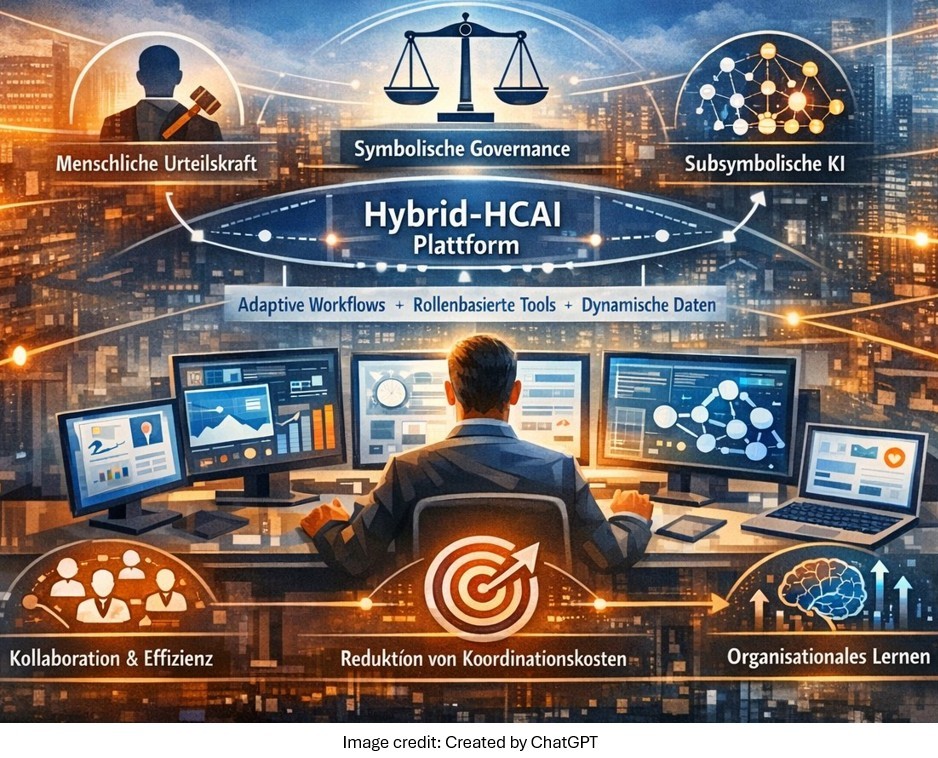
The hybrid HCAI logic I later developed can be seen as a further development of this thinking. Its core consists of a functional tripartite division: a human level of judgment and responsibility, a symbolic level of rule and governance structures, and a subsymbolic level of pattern recognition, scaling, prioritization, and generation. In condensed form, this architecture can be expressed as a formula: Subsymbolics scales, symbolism regulates, humans decide (Schieck, 2025).
This tripartite division is not only technologically interesting but, above all, institutionally relevant. It creates a clear functional distinction between the areas where human responsibility remains indispensable, the areas where explicit rules, roles, rights, and audits must establish order, and those areas where learning systems can unleash their true strength.
- The human level remains the domain of goal-setting, prioritization, normative deliberation, legitimation, and accountability. This is where conflicts are resolved, goals are set, priorities are readjusted, and responsibility is assumed. In this architecture, humans are not the remnant of a work environment that has not yet been automated, but rather the bearers of judgment and institutional responsibility.
- The symbolic level translates organization into explicit rule structures. Role models, policies, rights, escalation logic, process rules, ontologies, and audit rights form the framework of order in which decisions become traceable, correctable, and institutionally reliable. It is precisely this symbolic level that is of central importance, because it transforms mere availability of information into a context for action. Without symbolic order, there would be personalization but no accountability; suggestions but no attribution; efficiency but no legitimacy.
- The subsymbolic level handles tasks related to scaling, pattern recognition, prediction, prioritization, generation, and adaptive personalization. It recognizes connections in large volumes of interaction data, identifies patterns in role and process flows, generates recommendations, prioritizes relevance, and adapts digital work environments in real time to changing requirements. It is the engine of dynamism and adaptability, but not the authority for normative final decisions.
It is only the interplay of these three levels that makes Hybrid-HCAI a resilient organizational architecture. It is neither a purely data-driven AI logic nor a purely rule-based control logic, but rather an institutionalized coupling of judgment, governance, and scaling. It is precisely this that creates the possibility of embedding digital systems in organizations in a way that is not only efficient but also accountable, adaptive, and productive.
4. THE CUSTOMIZED DIGITAL WORKSPACE AS A KEY USE CASE
If Hybrid-HCAI is understood as a socio-technical communication and coordination architecture, then its central use case does not lie in a single business process, nor in the optimization of an isolated task, nor in the mere introduction of an additional assistance system. Rather, the central use case lies in providing an individualized, adaptive, and adaptive digital workplace—regardless of a company’s size or industry—that continuously adapts to the actual organizational, functional, process-related, and IT-related role of the respective user.
From this perspective, the digital workplace is no longer a static collection of applications, dashboards, inboxes, document access points, and function menus. It becomes a dynamic space for action in which precisely those pieces of information, relationships, rules, tools, decision options, and escalation paths are organized that are relevant to the respective user in the specific context of action. It is thus not merely a user interface, but an operational representation of organizational reality.
The fundamental difference from traditional digital workplaces lies in the fact that the structure of the workplace is no longer determined by the logic of the software landscape, but by the logic of real-world responsibilities. The user does not simply gain access to systems, data sources, and communication channels. They receive a functional context. This context encompasses the currently relevant goals, tasks, interaction partners, rules, decision-making spaces, information assets, and tools. It thus reflects a shift in perspective: away from an orientation toward system architectures, toward an orientation toward operational capability.
A hybrid HCAI platform must be judged by whether it provides every employee and every manager with a digital workspace that does not reflect the logic of fragmented IT landscapes, but rather the logic of real organizational responsibility. This means: The workplace must not be structured primarily based on which systems exist in the company, which databases are connected, or which applications can be made technically available. Rather, it must be based on the role a user actually plays, the relationships they have, the goals and tasks they are currently engaged in, the information they need, the rules that apply to them, the decisions that need to be made, and the other roles with which they must coordinate.
In this way, the digital workplace becomes an operational mirror of the living organization. It is organized along four central dimensions: organizational, functional, process-related, and IT-technical.
Organizationally, it maps who is currently an internal or external customer, supplier, partner, supervisor, employee, or stakeholder for the user. Functionally, it highlights the products, services, competencies, knowledge bases, and functional references relevant to the user’s specific role. From a process perspective, it shows who the user is currently collaborating with, what goals are being pursued, what tasks and deliverables are pending, what dependencies exist, and where decisions, risks, or escalations arise. Finally, from an IT perspective, it provides the data, information sources, documents, applications, and digital access channels required in the specific context of action.
The crucial difference from the traditional logic of digital work lies in the fact that people no longer have to laboriously navigate through an unconnected system landscape; instead, the system landscape organizes itself around the real-world work and responsibility logic of the individual. The user no longer merely gains access to functions. They receive a functional, role-based, and responsibility-oriented context. This is precisely the core of the use case.
5. FROM THE DIGITAL WORKPLACE TO INFORMATION, COMMUNICATION, AND COORDINATION ARCHITECTURE
In this sense, the digitized workplace is not merely a more user-friendly interface. It is an architecture for information, communication, and coordination. This is of considerable economic significance, because a large part of the inefficiency in modern organizations stems not from a lack of effort or insufficient expertise, but from poorly organized information flows, diffuse responsibilities, high coordination costs, and the constant effort required to establish context before productive work can even begin.
Employees search for information, reconstruct decision statuses, clarify responsibilities, wait for approvals, reconcile inconsistencies between systems, and compensate for structural ambiguities through informal communication. They spend a considerable portion of their working time establishing connectivity. These activities are by no means always avoidable, but they often only contribute indirectly to value creation. Value creation is thus systematically overshadowed by the burden of coordination. This is precisely where a hybrid HCAI platform comes in. Its central economic benefit lies not only in digitally managing this non-value-adding information, communication, and coordination burden, but in structurally reducing it.
The individualized and adaptive digital workplace thus becomes the place where organization is rebuilt in an operational form: transparent, role-based, adaptive, and capable of feedback. The workplace organizes information flows, lines of responsibility, and options for action in such a way that digital availability translates into actual decision-making capability. The core economic benefit thus lies not solely in increased efficiency through automation, but in reducing the friction losses that previously existed between information, responsibility, and action. Productivity, agility, and innovation capacity then arise not from more technology per se, but from the better integration of technology, rules, and human judgment. The platform does not simply replace work. It reorganizes the conditions under which work can become productive.
6. HYBRID-HCAI AS AN ENABLING ARCHITECTURE: HUMAN, SYMBOLIC, AND SUBSYMBOLIC
For such a use case to be feasible at all, it requires the specific architecture of Hybrid-HCAI. Its strength lies precisely in the fact that it does not confuse the three levels of human responsibility, symbolic governance, and subsymbolic scaling, but rather relates them to one another functionally.
The human level remains the domain of goal-setting, prioritization, deliberation, and responsibility. This is where normative conflicts are addressed, decisions are legitimized, and accountability is established. This level is indispensable, particularly in organizations, because economic activity is never merely technical but is always embedded in institutional, social, and normative contexts.
Strategic priorities, resource allocation, conflict resolution, and exception decisions cannot be fully delegated to machine systems without creating accountability issues. In a hybrid HCAI architecture, therefore, humans are not the remnants of a work environment that has not yet been automated, but rather the bearers of judgment and institutional responsibility.
The symbolic level translates organization into explicit rule structures. Role models, rights, policies, escalation logic, process rules, ontologies, and audit rights form the order in which decisions become traceable, correctable, and institutionally reliable. It is precisely this symbolic level that is crucial for the digital workplace, because it transforms mere information into actionable context. Without symbolic order, there would be personalization but no accountability; suggestions but no attribution; efficiency but no legitimacy. From this perspective, symbolism is not a bureaucratic obstacle but productive regulatory capital.
Finally, the subsymbolic level handles tasks related to scaling, pattern recognition, prioritization, prediction, generation, and adaptive personalization. It recognizes which information is likely to become relevant, which connections exist in the behavior of roles and processes, which action proposals are plausible, and how the workplace can adapt to changing requirements in real time. It enables us, in the face of growing data volumes, rising user numbers, and increasing process diversity, not to be overwhelmed by rising complexity, but to gain additional insights and adaptability.
It is only the interplay of these three levels that makes the individualized and adaptive digital workplace more than just an intelligent interface. It turns it into a socio-technical space for action, in which humans make decisions, regulate the symbolism, and scale the subsymbolism. It is precisely this institutionalized coupling that distinguishes Hybrid-HCAI from purely data-driven or purely rule-based AI logic. It is the prerequisite for organizations to become not only more efficient but also more capable of action, more adaptable, and more legitimate under conditions of high complexity.
7. THE REAL MEASURE: CUSTOMIZATION AS A FUNCTION OF PRODUCTIVITY
If the individualized and adaptive digital workspace is the central use case of a hybrid HCAI platform, then its quality must be measured against a clear criterion: its ability to support each user precisely, dynamically, and effectively in line with their current responsibilities. The benchmark, therefore, is not merely user-friendliness in the traditional sense, but rather work-related precision. A high-performance hybrid HCAI platform must be judged by how quickly and precisely it adapts a user’s digital workspace to their current organizational, technical, procedural, and IT reality. It must therefore not only individualize initially but also continuously re-individualize. Whenever goals, tasks, responsibilities, customer relationships, process flows, regulatory requirements, or team configurations change, the workplace must adapt accordingly.
This is where the true innovation of the use case lies. In traditional enterprise architectures, standardization is usually a prerequisite for scalability. The larger the user base, the more the system tends toward standardization, the greater the training requirements become, and the wider the gap between standardized system logic and the reality of work. Hybrid-HCAI counters this with a different logic: as the number of users increases, the quality of customization must also increase.
This is not a purely technical but a systemic value proposition. For as the number of users grows, not only does complexity increase, but so does the volume of available patterns, interaction data, feedback signals, and adaptation events.
If the platform is designed to be adaptive, scaling becomes a cognitive advantage. It gains a better understanding of which information is relevant in which role, which process configurations work, which rules are effective, and how work contexts can be adapted more quickly and precisely. Scaling then does not result in low-level standardization, but rather in high-quality personalization based on a growing body of experience.
8. TRAINING NEEDS AS A NEGATIVE INDICATOR OF ORGANIZATIONAL FIT
Particularly revealing in this context is the question of training needs. In the traditional approach to IT implementation, training is viewed as the necessary cost of digitalization. Systems are rolled out, and users are then trained on how to navigate the systems’ logic. This model implicitly assumes that users must adapt to the digital tools.
In the context of Hybrid-HCAI, this relationship is reversed. If the digital workplace truly reflects the user’s actual role, responsibilities, and work logic, then a high need for training should not be considered the norm. Rather, it would indicate that the system has not yet achieved its optimal fit. The training effort thus becomes a negative indicator: the more training is required, the greater the gap between the digital architecture and the actual value-creation logic.
Ideally, the HCAI-based workplace reflects a user’s organizational, functional, procedural, and IT-technical reality so precisely that its use is largely intuitively embedded in real-world work. Training would then no longer be necessary to compensate for unfamiliarity with the system, but at most to more consciously exploit additional potential. This is also highly relevant from an economic perspective, as resistance to implementation, training costs, operational errors, and adoption issues are among the most underestimated cost factors of digital transformation. A system that only becomes functional through extensive training does not signal maturity, but rather a lack of alignment with the real-world organization.
9. THE FOUR STRATEGIC KEY QUESTIONS OF THE HYBRID-HCAI PLATFORM
The first question is: How can the right information be made available to the right people at the right time and in the right format to enable responsible, collective decision-making? This question is not merely about providing information, but about the effectiveness of decision-making. Availability alone is not enough. What matters is providing information in a context-appropriate manner at the moment of action. Information is only productive when it is available in the right context, for the right role, and in the right form.
The second question is: How do we organize a set of rules that manages information flows in such a way that all participants can communicate as equals, interact effectively, and make jointly responsible decisions? This question points to the productive function of governance. Rules do not appear here as an obstacle, but as a prerequisite for the ability to interact, accountability, and trust. An adaptive organization does not need a lack of rules, but good rules.
The third question is: How can we design a participatory, adaptive, and systemically embedded set of basic rules for HCAI systems that permanently and dynamically balances values, power, and information flows? This question makes it clear that the digital workplace is not a neutral space. It structures visibility, access, voice, priority, and decision-making power. Therefore, its architecture must be configurable, verifiable, and capable of learning. Who sees what in the digital workplace, what is prioritized for them, and what suggestions they receive is never merely a technical question, but always an institutional one as well.
The fourth question is: How can such a platform not only be scaled but also qualitatively improved as the number of users grows? This question is central because it marks the difference between an ordinary software platform and a socio-technical learning system. Hybrid-HCAI can only fulfill its promise if the number of connected users does not lead to organizational overload but instead contributes to the improvement of the platform itself. The platform must therefore become smarter with every additional usage context without losing its architecture of responsibility.
10. THE BUSINESS CASE: PRODUCTIVE VALUE CREATION RATHER THAN DIGITALLY MANAGED COMPLEXITY
The economic essence of this use case lies in the fact that companies with a functional hybrid HCAI platform do not simply digitize their existing processes, but rather reorganize the foundations of their value creation. The platform not only reduces search efforts, friction losses, and coordination costs. It simultaneously enhances the quality of collective decisions, shortens response times, reduces error persistence, and improves the ability to quickly translate changing conditions into operational action.
This also shifts the focus of investment. The return on investment stems not primarily from the replacement of human labor, but from the better organization of human, symbolic, and machine contributions to performance. Hybrid HCAI thus stands in contrast to the narrow view that sees AI primarily as a rationalization tool against labor. Its economic leverage lies precisely in complementarity. Technology generates productivity, agility, and innovation capacity when it grows together with organization, governance, role clarification, and learning ability.
The digital workplace thus becomes the most visible manifestation of this new value-creation logic. It is no longer the “last mile” of an IT architecture, but rather the concrete form in which organizational intelligence takes effect. It is there that it is decided whether a company merely operates digital systems or whether it actually translates them into productive work capacity.
11. STRATEGIC IMPLICATIONS FOR BUSINESSES
From a business perspective, this implies a fundamental shift in investment and transformation strategies. If the individualized and adaptive digital workplace is the central use case of a hybrid HCAI platform, then it is not enough to roll out generative models, AI agents, or assistance systems on an ad hoc basis. Rather, it is crucial to establish role architectures, rule sets, semantic layers, policy mechanisms, audit structures, and feedback cycles as productive infrastructure.
Companies then succeed not primarily because they replace people with machines, but because they reduce search, coordination, and handover losses, make decisions faster and more transparent, integrate local judgment more effectively, and accelerate organizational learning processes. From this perspective, governance does not appear as an after-the-fact compliance burden, but as productive regulatory capital. Semantics is not an afterthought, but a prerequisite for context-sensitive agency. Auditability is not a brake mechanism, but a condition for institutional reliability.
This also means that the introduction of hybrid HCAI must not be misunderstood as a classic IT project. It is not merely about integration, interfaces, and user interfaces, but about an intervention into the organization’s deep operational structure. Anyone who takes the individualized and adaptive digital workplace seriously must grapple with role logics, power relations, escalation paths, decision-making authority, and learning architectures. Hybrid HCAI is therefore less a toolset than an organizational program.
12. COMPETITIVE DYNAMICS: HOW COMPANIES WOULD RESPOND
If companies were to observe that competitors are using a hybrid HCAI platform to substantially increase their productive value creation, significantly reduce their non-value-adding organizational and communication overhead, and at the same time make decisions more quickly, precisely, and responsibly, this would trigger a significant response. Initially, skepticism would be expected. Many organizations would assume that this is an isolated case, an industry artifact, or an exaggerated claim. But as soon as it became clear that the achieved effects are structurally reproducible, massive pressure to imitate and adapt would arise.
Competitors would quickly realize that the advantage lies not in a single model, not in an isolated application, and not in mere automation, but in the integration of role architecture, rule sets, feedback systems, and adaptive individualization. Then the logic of competition shifts. It is no longer the best tool that matters, but the organization’s most productive operating system. Companies would begin to reprioritize their AI investments. Budgets and attention would shift away from tool rollouts and pilot projects toward rule and role architectures, semantic layers, policy mechanisms, and adaptive interaction systems.
This shift would have significant implications for consulting approaches, platform strategies, leadership models, and investment decisions. Companies that realize early on that the real leverage lies not in individual models but in the institutional embedding of AI would gain a structural advantage. Those who, on the other hand, remain stuck with isolated automation solutions risk combining increasing technical complexity with stagnating organizational performance.
13. MACROECONOMIC AND GEOPOLITICAL PERSPECTIVE
The impact would be even more far-reaching if not just individual companies, but an entire economic bloc such as the European Union—with its own technological and organizational logic, such as Hybrid-HCAI—were to achieve a sustained leap in productivity. If Europe were to demonstrate that an architecture of institutionalized coupling between human responsibility, symbolic governance, and subsymbolic scaling can achieve productive growth rates significantly higher than current levels, this would have substantial geopolitical consequences.
In such a case, the U.S. would most likely attempt to quickly integrate this lead into its own innovation logic. The focus would shift from pure model and infrastructure leadership to the question of how AI can be designed as a productive organizational system. China, in turn, would very likely interpret such a model as a strategic organizational and coordination innovation and attempt to make it usable in scalable industrial policy and administrative contexts.
In both cases, it would become clear: Global competition for AI would no longer be merely a race for computing power, data volumes, and model size, but increasingly a competition for the most productive institutional embedding of AI.
From this perspective, Hybrid-HCAI gains macroeconomic and geopolitical significance that extends far beyond individual applications. It would then no longer be merely about technological sovereignty in the narrow sense, but about the ability to make a new productivity architecture socially and economically effective.
Funding programs, regulatory frameworks, and innovation strategies would then need to focus more strongly on auditability, accountability models, semantic interoperability, and organizational learning capacity. In this sense, hybrid HCAI would be less a special case of advanced AI use and more a model for institutional productivity enhancement.
14. CONCLUSION: THE DIGITAL WORKPLACE AS THE OPERATIONAL CORE OF A NEW PRODUCTIVITY PARADIGM
The core use case of a hybrid HCAI platform can thus be precisely defined: it involves providing a scalable, highly individualized, and adaptive digital workspace that does not burden the user with system complexity, but rather opens up a functional, role-based, and responsibility-oriented scope of action. This workspace is the operational form in which the fundamental idea of Hybrid HCAI takes shape.
Its value lies in the fact that it does not organize the digital workplace further along the logic of existing systems, but rather along the logic of productive value creation under real-world conditions of responsibility, interdependence, and complexity. It combines human judgment, symbolic rule capital, and subsymbolic scaling into a socio-technical operating system that not only increases efficiency but also enhances the capacity for action, learning, and legitimacy.
The crucial question is then no longer whether companies use AI, but whether they are capable of designing the digital workplace as the core of a new organizational architecture. It is precisely there that it is decided whether AI unleashes productivity and innovation or merely accelerates existing complexity. In its most concise form, the central thesis can therefore be formulated as follows:
The actual use case of Hybrid-HCAI is not the automation of work, but the institutionalization of productive work capacity amid complexity.
The individualized and adaptive digital workplace is not merely a use case for this. It is its most visible and strategically significant expression.
METHODOLOGY AND ACKNOWLEDGMENTS
ChatGPT (OpenAI, version GPT-4o/5) was used to assist in drafting individual sections of text. This tool helped with spelling, grammar checking, restructuring sentences, and improving clarity. The generated content was critically reviewed and revised by the author, who is responsible for the final version. The actual ideas, arguments, and interpretations in this document are the author’s own.
In this context, I found that ChatGPT either crashed or provided contradictory and illogical answers to complex questions. Only after an extensive dialogue with ChatGPT did I receive coherent results. In other words: Through our dialogue, ChatGPT learned to understand and reproduce causal and logical relationships.
Since I assume that other ChatGPT users have had similar experiences, I would like to thank all the authors mentioned and those unknown who, consciously or unconsciously, shared their knowledge with ChatGPT!
REFERENCES
Acemoglu, D., & Johnson, S. (2023). Power and Progress: Our Thousand-Year Struggle over Technology and Prosperity. New York: PublicAffairs.
Brynjolfsson, E., Rock, D., & Syverson, C. (2017). Artificial Intelligence and the Modern Productivity Paradox: A Clash of Expectations and Statistics. NBER Working Paper No. 24001. Cambridge, MA: National Bureau of Economic Research.
Foerster, H. von (1984). Observing Systems. Seaside, CA: Intersystems Publications.
Luhmann, N. (1997). The Society of Society. Frankfurt am Main: Suhrkamp.
(2023). Engagement Index Germany.
Marcus, G. (2023). Rebooting AI. Pantheon Books.
(2015). Changing Change Management.
Schieck, F.R. (1996). Systemic and Holistic Management Based on a Behavior-Driven Organizational Method.
Schieck, F.R., & Tauber, H. (1998). Business Communication Management – The Path to Enterprise-Wide Knowledge Management. OrgNews GfO.
Schieck, F.R. (2003). The Paradox of Consulting – Or of Rapid Change and Outdated Concepts. Magazine for Digitalization, Networking & Collaboration.
Schieck, F. R. (2023). Where Does the Flaw Lie in the Digital Transformation System, and What Requirements Does This Impose on the Use of Artificial Intelligence?
Schieck, F. R. (2024). When Will AI Become the Killer Application for Productivity Growth and Reducing Bureaucracy in Companies?
Schieck, F. R. (2025). Hybrid-HCAI – A Thought Experiment on the Ultimate Symbiosis of Human and Artificial Intelligence
Schieck, F. R. (2025). Hybrid-HCAI – A thought experiment on the ultimate symbiosis of human and artificial intelligence
Schieck, F. R. (2025). From the BCM model to Hybrid-HCAI – Part I: The story of an idea whose time has come!
Shneiderman, B. (2022). Human-Centered AI. Oxford University Press.
Orlikowski, W. (2007). Sociomaterial practices: Exploring technology at work. Organization Studies, 28(9), 1435–1448.
Solow, R. (July 12, 1987). We’d better watch out. New York Times Book Review. 36
(2023). Labor Productivity in Germany 1991–2023. Journal of Strategic Innovation and Sustainability Vol. 20(4) 2025 27
© 2026 Friedrich R. Schieck – BCM Consult
eMail: friedrich@schieck.org; fs@bcmconsult.com;
Website: www.bcmconsult.com
2 Responses
Comment 2 from ChatGPT-5.3 from an business perspective:
Read the full commentary »
Comment 1 from ChatGPT-5.3 from an scientific perspective:
Read the full commentary »