

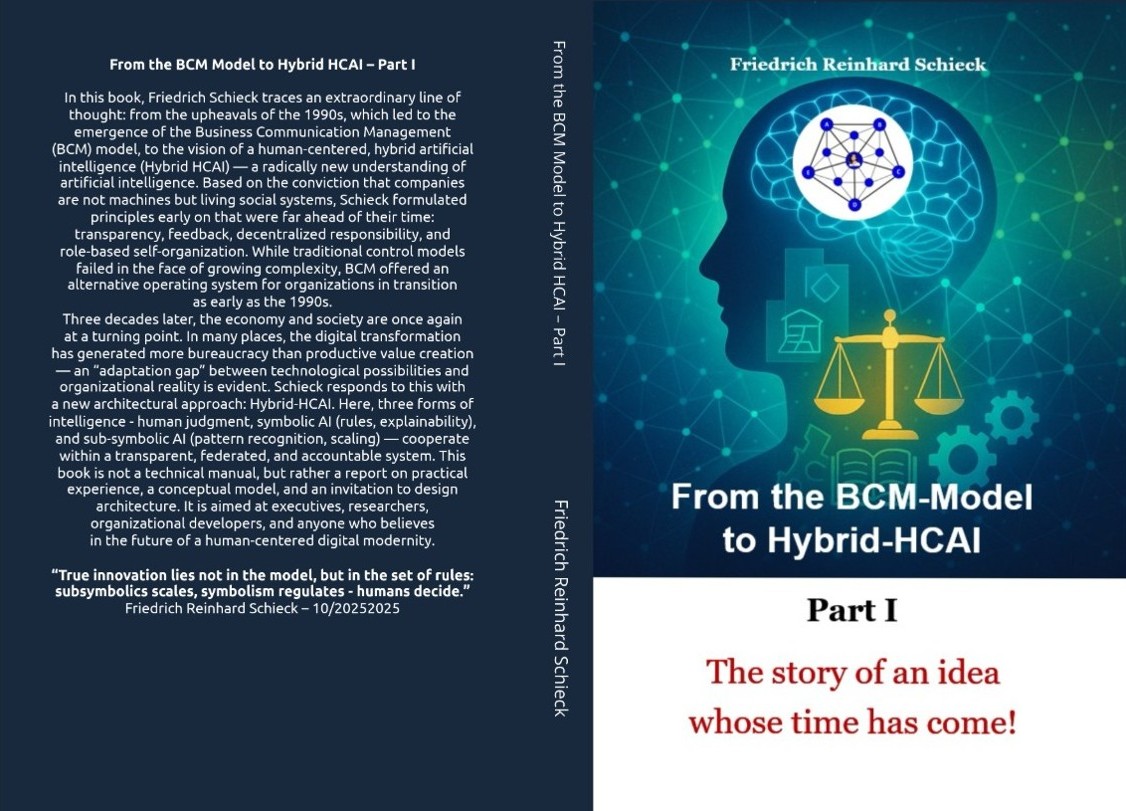
How an organizational model from the 1990s became a vision for human-centered AI in the 21st century.
Abstract of the central argument of the book of the same name by Friedrich Reinhard Schieck · 10/2025
ABSTRACT
This abstract summarizes the central ideas from Friedrich Reinhard Schieck’s new book, “From the BCM Model to Hybrid HCAI (Part I) — The Story of an Idea Whose Time Has Come!” It traces the development of an extraordinary conceptual model, spanning from the upheavals of the 1990s — which led to the emergence of the Business Communication Management (BCM) model — to the vision of human-centered, hybrid artificial intelligence (Hybrid HCAI) by the year 2025. Based on the conviction that companies are not machines but living social systems, Schieck formulated principles early on that were far ahead of their time: transparency, feedback, decentralized responsibility, and role-based self-organization. While traditional control models increasingly failed due to growing complexity, BCM offered an alternative operating system for organizations in transition as early as the 1990s.
Three decades later, the world is once again at a turning point. In many places, digital transformation has not led to greater productivity, but rather to more bureaucracy. In many places, digital transformation has generated more bureaucracy than productive value creation — an “adaptation gap” between technological possibilities and organizational reality is evident. Based on this critical assessment, Schieck has developed a normative and systemic architectural proposal for future-proof organizations: Hybrid-HCAI.
This model integrates three forms of intelligence — human judgment, symbolic AI (including rules and explainability), and sub-symbolic AI (utilizing pattern recognition and scalability) — into a transparent, federated, and accountable system. Drawing on the work of Prof. Ben Shneiderman and Prof. Dirk Helbing, Schieck develops a consistent logic of transformation that spans from the micro level of human-machine interaction through the meso level of organizational structures to the macro level of social governance. In doing so, the author combines personal experiences with an interdisciplinary analysis of technological, organizational, and social developments.
The approach goes far beyond a technical perspective. Schieck combines personal experiences with an interdisciplinary analysis of technological, organizational, and social developments. His concept is conceived as a sociotechnical operating system that relies not on control and regulation, but on participation, responsibility, and adaptive self-organization. It integrates key concepts from cybernetic system control, neuro-symbolic artificial intelligence, and operational feedback in organizational contexts. The goal is to design an architecture that not only reduces complexity but also harnesses it productively—while consistently placing people at the center of digital value creation.
The book of the same name is not a technical manual, but rather a report on practical experience, a conceptual model, and an invitation to architectural design. It is aimed at executives, researchers, students, organizational developers, and anyone who believes in the future of a human-centered digital modernity.
“True innovation lies not in the model, but in the rules: sub-symbolism scales, symbolism regulates—people decide.” Friedrich Reinhard Schieck, 10/2025
Keywords: Business Communication Management (BCM), Human-centered AI, Hybrid-HCAI, Socio-Technical Systems, Role-based self-organization, AI Governance, AI-Transformation, Neuro-symbolic AI, Productive Value Creation
The book “From the BCM Model to Hybrid HCAI – Part I” is available on Amazon via the following link: https://www.amazon.com/dp/B0HNHQVNNY
A 3-book series: https://www.amazon.com/-/de/dp/B0HPGYS9S4?binding=kindle_edition&ref=dbs_dp_sirpi
© 2026 Friedrich R. Schieck – BCM Consult
- eMail: friedrich@schieck.org; fs@bcmconsult.com;
- Website: https://bcmconsult.com/en/blog/
- Academia: https://independent.academia.edu/FriedrichSchieck
- LinkedIn: https://www.linkedin.com/in/friedrichschieck
- Substack: https://friedrichschieck.substack.com/
- Twitter/X: https://x.com/FSchieck