

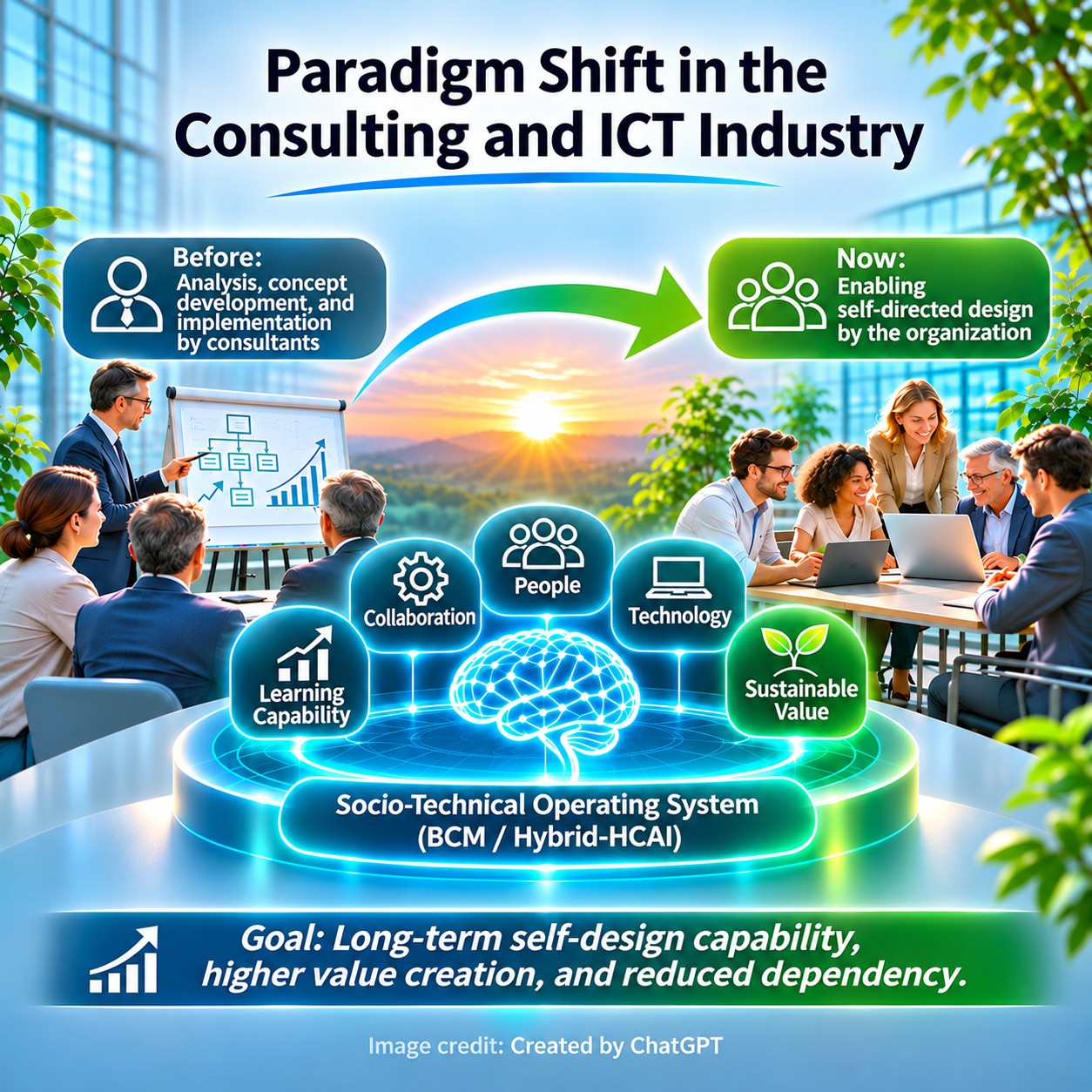
A Socio-Technical Architecture of Collective Intelligence and the Potential Disruptive Consequences for the Business Model of the Consulting and ICT Industries!”
A Preview of My New Book: “From the BCM Model to Hybrid HCAI – Part III: Author: Friedrich R. Schieck, Published – November 2026
ABSTRACT
The current development of artificial intelligence may be facing a fundamental economic and social contradiction: While technology companies are investing billions in increasingly powerful AI models, autonomous agent systems, and global computing infrastructures, the promised broad gains in productivity and profitability from the AI transformation have, in many cases, yet to materialize. Companies can significantly accelerate individual cognitive tasks without a corresponding increase in their economic performance. At the same time, the costs associated with digitization, organizational restructuring, software integration, change management, and the deployment of additional AI applications are rising. The technology is becoming more powerful—but the organization of its economic use is not necessarily becoming more productive.
Economic research explains this discrepancy primarily through the “Productivity J-Curve” proposed by Erik Brynjolfsson, Daniel Rock, and Chad Syverson. According to this model, foundational technological innovations require extensive complementary investments in organizational capabilities, business processes, business models, and human capital before their productivity effects become apparent. This interpretation is theoretically plausible and historically grounded.
However, it raises a crucial question that may be underestimated in the current discussion of AI productivity:
What happens if a significant portion of those organizational transformation costs—which are considered necessary complementary investments—are in fact caused by the application of transformation methods that are methodologically and architecturally unsuitable?
This is precisely where the Methodology-Induced Productivity Paradox Hypothesis (MIPPH) comes into play. It posits that an economically significant portion of the AI productivity paradox is not attributable solely to unavoidable adjustment periods or intangible investments that are inadequately captured by statistics, but rather to Methodology-Induced Transformation Losses (MITL): methodologically avoidable transformation losses that arise from traditional, phase-oriented organizational and digitization methods that are structurally ill-suited to the capabilities of artificial intelligence.
This calls into question not only the efficiency of individual AI projects. At issue is the economic viability of a transformation strategy on which significant parts of the business model of the global consulting and ICT industries are based. If companies first analyze, restructure, optimize, and digitize their existing structures in order to subsequently integrate AI systems, they could end up devoting considerable resources to perfecting an organizational past whose functional prerequisites are already being fundamentally transformed by artificial intelligence.
This essay contrasts this development with the Business Communication Management (BCM) concept developed by Friedrich Reinhard Schieck and its further development into federated, neuro-symbolic Hybrid Human-Centered Artificial Intelligence (Hybrid-HCAI). The starting point is the assumption that economic and social performance does not depend solely on the intelligence of individual actors or the capabilities of the technologies employed, but is largely determined by the architecture of the information, communication, interaction, and decision-making processes through which people, artificial intelligences, organizations, and institutions are interconnected.
This gives rise to an alternative logic of transformation: existing processes should not first be optimized and then automated. Rather, the value-creation architecture should be designed from the outset to facilitate the complementary, rule-based, and adaptive interaction between human and artificial intelligence. The focus is on individualized digital workplaces, federated knowledge and information spaces, institutionally legitimized governance rules, controllable AI agents, and recursive mechanisms of collective learning.
Should such an architecture empirically confirm its theoretically grounded potential, the economic consequences could extend far beyond the automation of individual tasks. Companies could develop the capabilities to provide a significant portion of the organizational consulting, process optimization, and digital adaptation services they previously sourced externally – in-house and on an ongoing basis. Traditional application silos, proprietary integration architectures, and costly transformation projects could, in some cases, lose their economic necessity. The consulting and ICT industries would thus be affected by a twofold disruption: AI could not only reduce the costs of their services but also structurally alter part of the demand for these services.
Looking further ahead, the essay explores the possibility of a global, federated hybrid HCAI platform that connects human and artificial intelligences within a collectively learning architecture. Under suitable algorithmic and institutional conditions, this could give rise to a new form of general collective problem-solving capability, for which the term “Hybrid Collective Artificial General Intelligence” (Hybrid-CAGI) is proposed as a research hypothesis.
The central thesis is this:
The potentially most profound economic and social disruption of the AI era might not arise from the development of another generation of powerful AI models, but rather from the replacement of an outdated logic of transformation with a socio-technical architecture that organizes the collective intelligence of human and artificial actors in a productive, self-adaptive, and institutionally accountable manner.
MIPPH is not a proven theory, but rather a sharpened, scientifically testable counter-hypothesis to a simplistic interpretation of the Productivity J-Curve. Its significance lies precisely in making the productivity of traditional transformation methods—which has often been taken for granted—the very subject of economic research.
Keywords: Productivity J-Curve, Methodology-Induced Transformation Losses, MIPPH, Productive Complementary Investments, BCM, Hybrid-HCAI, Hybrid-CAGI, Adaptation Gap, socio-technical architecture, collective intelligence, neuro-symbolic AI, federated governance, transaction costs, consulting, ICT, artificial intelligence, digital sovereignty, recursive learning.
TABLE OF CONTENTS
- The Billion-Dollar Illusion of the AI Revolution: When Technological Capability Is Confused with Economic Productivity
- The Productivity J-Curve: A Plausible Explanation—and a Potentially Disastrous Conclusion
- The Methodology-Induced Productivity Paradox Hypothesis: When the Solution to the Productivity Problem Itself Becomes a Productivity Problem
- The Fundamental Methodological Flaw: Why Companies Optimize the Past Instead of Shaping the Future of Their Value Creation
- The Adaptation Gap: When Organizations Create Their Own Adaptation Gap
- The Real Productivity Question Is a Systems-Theoretical One: Who Organizes the Information, Communication, and Interaction Processes?
- From the BCM Model to Hybrid HCAI: The starting point must be not existing business processes, but the complementary capabilities of human and artificial intelligence
- The Individualized and Adaptive Digital Workplace: The End of Humans Adapting to Software?
- Four Architectural Questions Determine Whether Networked Intelligences Actually Give Rise to Collective Intelligence
- The Real Alternative: A federated, neuro-symbolic architecture for self-adaptive and collectively learning human-AI systems
- The first disruption: When the consulting industry is not only automated but its economic business model is called into question
- The second disruption: When the ICT industry must overcome its own integration and application silos—information order, economic separation of powers, and systemic security
- The third disruption: When the intelligence of the architecture becomes economically more important than the intelligence of the individual AI model
- The dual disruption: When AI not only automates a service but could also eliminate its economic necessity
- The societal flip side of the AI boom: Five risks that could reinforce one another
- “We Must Act Now”—but is it enough to regulate the societal consequences of a methodologically misguided transformation?
- The economic and political separation of powers: Who will control the architecture of collective intelligence in the future?
- The billion-people hypothesis: What happens when a hybrid HCAI platform reaches global scale?
- Hybrid CAGI: Could general intelligence emerge as an emergent capability of a socio-technical architecture?
- The Economic Implications of MIPPH: A Possible Reassessment of Global Transformation Expenditures
- The Scientific Test: How Can We Prove That the Transformation Methodology Itself Causes Productivity Losses?
- From the BCM Model to Hybrid-HCAI – Part III: From a Critique of the Economics of Transformation to the Architecture of Responsible Collective Intelligence
- Conclusion: Perhaps the greatest disruption of the AI era could be the transformation of transformation methods
1. THE BILLION-DOLLAR ILLUSION OF THE AI REVOLUTION: WHEN TECHNOLOGICAL CAPABILITY IS CONFUSED WITH ECONOMIC PRODUCTIVITY
The history of the modern economy is also a history of promises of technological progress. New machines, new energy sources, new information systems, and new forms of automation were intended to make human labor easier, increase productivity, and create prosperity. In many cases, these expectations were met in the long term. However, this often did not happen in the way originally anticipated—and certainly not automatically. With the development of generative artificial intelligence, these expectations of progress have taken on a new dimension. Large language models can compose texts, analyze complex documents, develop programs, extract scientific information, formulate decision recommendations, and, in some cases, take on tasks that previously required highly skilled human workers. Multimodal systems process different forms of information, while autonomous AI agents are increasingly able to coordinate entire sequences of actions. Leading technology companies are investing enormous financial resources in the development of even more powerful systems. The underlying economic expectation seems convincing at first glance: If more and more intellectual tasks can be performed faster and more cost-effectively, this should sooner or later translate into correspondingly higher productivity rates and corporate profits.
Yet it is precisely this seemingly self-evident conclusion that could prove to be one of the fundamental fallacies of the current AI transformation. In his analysis “No Signs of AI Payoff Outside the Tech Sector” dated October 24, 2026, Torsten Slok, chief economist at Apollo Global Management, points to a striking discrepancy between the financial returns of leading technology companies and the economic performance of large U.S. companies outside this sector. While the so-called “Magnificent Seven” are posting rising revenue per employee and higher profit margins, the other S&P 500 companies examined by Slok have not yet shown a comparable trend. Slok interprets this as an indication that the financial returns of the AI boom have so far been virtually nonexistent outside the technology sector. [1] This finding does not prove that AI does not generate economic benefits. Nor does it show that all industries and companies are affected to the same extent. Above all, such a comparison does not yet allow for a causal explanation of the productivity paradox. However, it points to a contradiction that is of central importance for the economic assessment of artificial intelligence.
The International Labor Organization examines this relationship in its research report, *The Aggregation Paradox of AI: Why Do Micro-Economic Productivity Gains from AI Disappear at Scale?*, published in May 2026. The report shows that significant productivity gains at the level of individual tasks and workers do not automatically translate into corresponding effects at the firm, industry, or national economic levels. [2] This calls into question an assumption on which numerous economic forecasts are based: that productivity gains from individual AI applications can largely be added together to boost the performance of entire companies and economies. However, this is by no means a given. An organization is not merely a collection of individual jobs. It is a complex social system comprising people, tasks, competencies, information flows, decision-making authority, technologies, expectations, and institutional rules. Its economic performance does not arise solely from individual people or machines performing their tasks more quickly, but rather from the meaningful coordination of their efforts.
An example illustrates this issue. Suppose a company uses generative AI to produce market analyses, project reports, decision-making documents, and technical documentation much more quickly. The processing time required for this is significantly reduced. At the same time, however, the organizational coordination and decision-making processes remain unchanged. The documents produced go through the same hierarchies, approval procedures, and review stages as before. Additional AI-generated information must be evaluated and reconciled with other information. Conflicting results lead to new rounds of coordination. Responsible executives must decide which AI results are reliable and which are not. As a result, the acceleration of individual tasks can be partially or even completely offset by additional coordination, review, and integration costs. The organization produces more information, but not necessarily more economic value. It has more powerful tools at its disposal, without its fundamental decision-making and value-creation architecture having improved accordingly.
This creates a paradoxical situation:
Artificial intelligence can increase the productivity of individual tasks while simultaneously increasing the complexity of the overall system if the architecture governing their interaction remains unchanged.
The economic challenge, therefore, lies not solely in developing increasingly powerful AI models. It lies in the ability to translate technological possibilities into a productive organization of human and artificial intelligence. This is where the real problem begins. For the methods companies have been using for decades to attempt this translation could themselves be a major part of the reason for the lack of productivity gains.
2. THE PRODUCTIVITY J-CURVE: A PLAUSIBLE EXPLANATION – AND A POTENTIALLY DISASTROUS CONCLUSION
The productivity paradox is not a new phenomenon. As early as 1987, Robert Solow pointed out the striking discrepancy between the growing prevalence of computer technology and its limited visibility in productivity statistics at the time. [3]
Erik Brynjolfsson, Daniel Rock, and Chad Syverson addressed this issue with their theory of the Productivity J-Curve, published in 2021. Their explanatory model is based on the observation that foundational technologies require extensive complementary investments before their economic potential can be fully realized. New technical capabilities must be integrated with appropriate organizational structures, business processes, skills, and business models. A significant portion of these investments creates intangible assets whose economic value is only partially reflected in official productivity statistics. [4]
This explanation is theoretically sound. It provides a convincing interpretation of why technological innovations may lead to measurable productivity gains only after a time lag. However, it becomes problematic when this explanation is used to derive an almost unquestionable justification for existing transformation practices. After all, the fact that new technologies require complementary organizational investments does not in any way mean that the investments actually made are economically sound, methodologically appropriate, or necessary in their scope. It is precisely this distinction that could be decisive for the current AI transformation.
When a company spends substantial financial resources on organizational analyses, restructuring, process optimization, software integration, and change management, real costs are incurred initially. Whether these expenditures actually create productive organizational capital, however, is a separate economic question. Part of this spending can undoubtedly add value. Companies need suitable information systems, clear decision-making authority, new competencies, and effective forms of human collaboration. Without the appropriate organizational capabilities, technological innovations can hardly be utilized economically.
Another part of the transformation expenses, however, may be attributable to methodologically avoidable inefficiencies. These include repeated structural and process analyses, the integration of technologically outdated target models, unnecessary organizational interfaces, long-term dependencies on proprietary application systems, poorly coordinated software architectures, and additional restructuring that becomes necessary because a previously implemented solution does not meet actual requirements.
The central question, therefore, is not whether complementary investments are necessary. In many cases, they undoubtedly are. The crucial question is rather:
Which complementary investments are actually productive – and which arise solely because companies are trying to integrate new technologies into existing organizational structures using inappropriate methods?
This distinction leads directly to the Methodology-Induced Productivity Paradox Hypothesis (MIPPH). The MIPPH does not dispute that the Productivity J-Curve describes a real economic relationship. Nor does it dispute that new technologies require time to unfold their economic effects. Rather, it challenges an interpretation in which the costs of organizational adaptation are implicitly equated with the accumulation of productive organizational capital. After all, an expenditure does not become productive simply because it occurs within the context of a transformation. A complex restructuring is not inevitable merely because it was planned by experienced consultants.
And the repeated adaptation of information systems is not a necessary investment in the future simply because it is linked to a technological innovation. This is precisely where the theoretical crux of the MIPPH lies:
Part of what is interpreted as a necessary investment in adaptation could in fact represent the price companies pay for using the wrong adaptation methods.
Under this assumption, the Productivity J-Curve would not be incorrect. However, its interpretation would be incomplete. In addition to the time-based accumulation of productive intangible assets, it could also obscure the economic impacts of inappropriate transformation processes. This would fundamentally alter the scientific perspective. The question would no longer be merely why companies must wait for a return on their investments. It would also be whether they are investing in the right form of organizational performance at all.
3. THE METHODOLOGY-INDUCED PRODUCTIVITY PARADOX HYPOTHESIS: WHEN THE SOLUTION TO THE PRODUCTIVITY PROBLEM ITSELF BECOMES THE PRODUCTIVITY PROBLEM
The central hypothesis of MIPPH can be stated as follows:
A significant portion of the current AI productivity paradox may not stem from unavoidable technological adjustment periods, but rather from methodologically induced transformation losses resulting from the application of traditional, predominantly phase-oriented, and structurally unsuitable organizational and digitization methods.
This hypothesis links two issues that have often been considered separately until now: the economic productivity of new technologies and the economic productivity of the methods organizations use to adopt these technologies. Its particular significance lies in the fact that it makes the transformation methodology itself an economic explanatory variable. For the sake of scientific precision, two categories must be distinguished.
Investments that actually create new, economically usable capabilities can be referred to as Productive Complementary Investments (PCI). These include, for example, the development of relevant competencies, interoperable infrastructures, clear accountability structures, and organizational capabilities that can be used over the long term. In contrast, Methodology-Induced Transformation Losses (MITL) refer to the additional resource consumption and lost economic benefits attributable to methodologically avoidable misalignments. These may include direct project costs, extended implementation times, redundant adjustments, premature technological obsolescence, and unrealized value-creation potential.
This analytical distinction is crucial. Not every costly transformation is inefficient, and not every failed investment is caused by methodological issues. Technological uncertainty, market changes, regulatory requirements, and unavoidable learning processes can generate significant costs, even when an organization proceeds in a methodologically sound manner. An MITL therefore exists in the strict scientific sense only if an economic disadvantage can plausibly be attributed to a specific transformation methodology and would have been lower had a suitable alternative approach been taken.
This highlights the difference from the conventional interpretation of the Productivity J-Curve. The J-Curve examines, in particular, why the productivity effects of foundational technological innovations may become apparent only after a time lag. The MIPPH complements this perspective by asking whether part of this delay is even necessary. This is more than a minor methodological detail; it concerns the fundamental assessment of economic transformation.
Suppose a company invests significant resources in analyzing existing business processes, develops optimized target processes based on this analysis, and then implements new ICT systems. After implementation, it becomes apparent that powerful AI systems could organize key parts of the newly implemented division of labor in a fundamentally different way. New projects become necessary, some of the investments already made lose their economic value, and organizational structures must be readjusted. From a traditional perspective, this development could be interpreted as a reflection of the rapid pace of technological progress.
From the MIPPH perspective, however, a different question arises: Could a transformation methodology that takes into account—from the very beginning—the complementary capabilities of human and artificial intelligence, as well as the continuous adaptability of the overall system, have prevented some of these expenses? If that were the case, these costs would not be exclusively unavoidable innovation costs. They would be, at least in part, methodologically induced transformation losses. This is where the hypothesis holds potential to shake up the field of economics.
If it could be demonstrated that traditional transformation methods systematically generate avoidable adjustment costs, then it would not only be the use of artificial intelligence that would be inefficient. Part of the current transformation industry might itself be contributing to the very productivity problem whose solution it markets as a service.
This conclusion should be understood as a conditional hypothesis. It is not a blanket assertion that consulting or ICT firms provide inefficient services or deliberately cause such inefficiencies. However, it highlights a potential structural conflict of interest: A service industry whose revenue is partly derived from the analysis, integration, and repeated adaptation of complex organizational and ICT structures does not necessarily have to follow the same economic incentives as a company that seeks to permanently reduce this complexity. It is precisely this tension that warrants an independent study from the perspective of organizational economics.
4. THE FUNDAMENTAL METHODOLOGICAL ERROR: WHY COMPANIES OPTIMIZE THE PAST INSTEAD OF SHAPING THE FUTURE OF THEIR VALUE CREATION
The traditional approach to organizational digitization is often based on a sequence that has been considered methodologically sound for decades. The process begins with an analysis of the existing organization. The organizational structure, operational processes, business processes, information flows, areas of responsibility, and application systems are mapped out. Building on this, consultants and internal project teams identify areas for improvement, develop new target structures, and define requirements for technical implementation. Subsequently, suitable ICT systems are selected, adapted, integrated, and rolled out. Training and change management are intended to ensure that employees can adapt to the new organizational and technical conditions.
This approach seems logical because it breaks down complexity into predictable steps. Its weakness, however, may lie in the choice of starting point. The existing organization becomes the reference architecture for its own future. Even when the intended changes are far-reaching, their design is often based on the perspective of existing tasks, processes, and organizational functions. For traditional automation technologies, this often made sense. When a machine performs a known production step more quickly or software digitally supports a defined administrative process, the future organization of work can be derived, at least in part, from the existing one.
With modern AI systems, however, this prerequisite no longer holds true without further consideration. Generative AI and increasingly autonomous agent systems do not merely alter the speed at which existing tasks are performed. They can also change the way information is interpreted, problems are defined, alternative courses of action are developed, decisions are prepared, and work is distributed between humans and machines. As a result, the organization of work itself becomes the subject of technological innovation.
However, when the functional basis of tasks and the division of labor changes, optimizing existing processes can become the wrong methodological starting point. As early as 1990, in the context of business process reengineering, Michael Hammer criticized the mere automation of existing workflows and called for a fundamental redesign of business processes. [5] The development of today’s AI systems significantly exacerbates this problem. Even a fundamentally redesigned process can become ill-suited if its architecture is based on a largely static target vision, while the capabilities of its human and artificial actors are constantly changing.
The danger then lies not only in automating existing processes instead of redesigning them. The danger lies in implementing even the redesigned processes as comparatively stable organizational structures, even though the underlying technological capabilities are self-adaptive and dynamic. This creates a paradoxical situation.
Companies invest considerable resources to prepare for the future. However, while the corresponding projects are being implemented, that future changes. The originally defined target scenarios lose some of their validity. New requirements arise, further integrations become necessary, and the organization must be adapted once again.
In this way, transformation programs can turn into a recurring cycle whose economic benefits do not necessarily increase in proportion to its costs. The root cause of this is not necessarily a lack of willingness among employees to embrace change. It could lie in the transformation architecture itself. The organization is repeatedly transitioned from a defined initial state to a preplanned target state, rather than being designed from the outset to be capable of continuous, accountable, and largely self-organized adaptation.
The actual methodological error, therefore, might lie in attempting to design a dynamic, collectively adaptive human-AI organization using approaches whose fundamental logic stems from the planning and implementation of relatively stable organizational states.
The economic consequences would be significant. It is not just the duration of a transformation that would become a problem. Rather, the chosen methodology could repeatedly generate new transformation needs.
5. THE ADAPTATION GAP: WHEN ORGANIZATIONS CREATE THEIR OWN ADAPTATION GAP
The MIPPH can be linked to the concept of the “adaptation gap,” which was developed within the BCM/Hybrid HCAI framework. The adaptation gap describes the discrepancy between the pace of technical, economic, political, and societal changes and the ability of social systems to adapt and further develop their organizational, informational, communicational, and procedural structures accordingly. Technological innovations can sometimes undergo fundamental changes within a matter of months. Organizations, on the other hand, are based on roles, responsibilities, hierarchies, procedures, cultural expectations, and technical infrastructures that have evolved over time. Adapting them requires coordination, legitimization, training, and often significant financial resources. This can result in a growing gap between what is technologically possible and what is actually usable from an organizational perspective. The obvious solution is to accelerate organizational transformations.
But this is precisely where MIPPH delves deeper. What if the adaptation gap arises not merely because organizations react too slowly to technological changes, but because they use methods that systematically reproduce this gap? In that case, merely accelerating traditional transformation programs would not be a sufficient solution. If companies merely develop and implement unsuitable target architectures more quickly, they may simply shorten the time until the next necessary restructuring without sustainably improving their structural adaptability. The real task, therefore, would be to change the nature of the transformation. An organization would need to be able to continuously refine its information flows, task relationships, decision-making mechanisms, and technical capabilities without having to redefine its entire structure at regular intervals.
The adaptation gap would then not merely be a challenge of organizational change velocity. It would be a challenge of socio-technical architecture. And the MIPPH would explain a possible mechanism through which this adaptation gap is economically amplified. This also shifts the question regarding the productivity of artificial intelligence. Neither the number of AI applications deployed nor the speed of their implementation would be decisive on their own. What would be decisive is the extent to which an organization improves its fundamental ability to productively leverage new technological opportunities without incurring disproportionate additional transformation costs. This is where the connection to the BCM/Hybrid HCAI architecture emerges.
6. THE REAL QUESTION OF PRODUCTIVITY IS A QUESTION OF SYSTEMS THEORY: WHO ORGANIZES THE PROCESSES OF INFORMATION, COMMUNICATION, AND INTERACTION?
Every social system develops and changes based on the processes of information, communication, and interaction among its members. Without these processes, there would be neither families nor businesses, neither government institutions nor social orders. This observation, which at first glance may seem self-evident, has far-reaching implications. For the development of a social system does not depend solely on what information its members possess, what skills they have, or what technical resources are available to them. It is significantly influenced by the rules according to which people communicate with one another, cooperate, resolve conflicts, and make joint decisions.
Who has access to what information? Who is allowed to communicate with whom? Who decides how tasks are distributed? Who can change the rules? Who bears responsibility for decisions? And who has the power to exclude others from information, decision-making processes, or social resources?
These questions do not merely concern the efficiency of organizational processes. They concern the very foundations of human community. For more than two and a half millennia, philosophers, social theorists, and political thinkers have been grappling with the rules of human coexistence. From Confucius and Aristotle through Hume, Kant, Arendt, and Fromm to modern systems-theoretical and cybernetic approaches, a common fundamental question can be identified:
How must the relationships between individuals and communities be structured to make human coexistence, individual fulfillment, and social stability possible?
The answers to this question vary considerably. This, in particular, illustrates that social order is not a purely technical matter. With his theory of social systems, Niklas Luhmann developed a perspective in which communication appears not merely as an exchange between pre-existing social structures, but as a fundamental operation through which social systems reproduce themselves.[6] Heinz von Foerster’s second-order cybernetics broadens the view to include the role of the observer and the conditions of knowledge. It makes clear that the observation and description of social systems cannot be understood independently of the perspectives of their observers.[7] Norbert Wiener, W. Ross Ashby, and Ludwig von Bertalanffy provided further essential foundations for understanding feedback, control, complexity, and system organization.
Combining these insights leads to a fundamental conclusion for the age of AI: The performance of a social system is not solely a property of its individual members. It arises primarily from the organization of their relationships and the rules according to which information is processed, expectations are coordinated, and actions are linked. As a result, information and communication technologies take on a social significance that goes beyond their technical function. ICT systems shape what information reaches people, what forms of collaboration become possible, and according to what rules decisions can be prepared and implemented. Artificial intelligence dramatically expands these possibilities. It can not only store, transmit, and retrieve information, but also generate, prioritize, and evaluate content, identify connections, and, increasingly, trigger actions on its own.
As a result, AI architectures have the potential to become an integral part of the institutional order of social systems. Those who define the rules of an AI platform influence more than just technical processes. They can indirectly determine what information becomes visible, which courses of action appear preferable, which interests are taken into account, and how economic or societal decisions are prepared. Herein lies one of the most profound challenges of the AI transformation. We engage in intense debate about which tasks artificial intelligence can automate. Far less attention is paid to the question of how the algorithmic shaping of human information, communication, and interaction processes could influence the direction of development for entire organizations and societies.
Yet this question is by no means new. Religions, cultural traditions, political systems, and social institutions have produced rules for human coexistence over millennia. These rules influence the distribution of power, the scope for individual self-determination, social conflicts, and the development of shared values. Artificial intelligence will not simply replace such cultural and institutional orders. However, it can significantly influence how they manifest themselves in everyday information, communication, and decision-making processes.
This leads to a pointed thesis:
The central question of power in the AI era may lie less in who owns the most intelligent machines and more in who controls the architecture and rules according to which human and artificial intelligences collaborate.
It is precisely at this point that the economic MIPPH converges with the philosophical, systems-theoretical, and institutional foundations of the BCM/Hybrid HCAI approach.
7. FROM THE BCM-MODEL TO HYBRID-HCAI: THE STARTING POINT SHOULD BE NOT EXISTING BUSINESS PROCESSES, BUT RATHER THE COMPLEMENTARY CAPABILITIES OF HUMAN AND ARTIFICIAL INTELLIGENCE
The Business Communication Management (BCM) concept is based on the fundamental information, communication, and interaction processes of social systems. It starts from the assumption that economic performance does not result solely from the optimization of individual resources or processes, but rather, to a large extent, from the way in which people coordinate their skills, knowledge, and actions with one another. The further development into federated, neuro-symbolic Hybrid Human-Centered Artificial Intelligence (Hybrid-HCAI) expands this perspective to include artificial intelligence. This fundamentally changes the framework for organizational transformation.
The existing structural and operational organization should no longer be regarded as a given starting point into which new technologies must be integrated. Rather, from the very beginning, we should examine how human intelligence, artificial intelligence, explicit institutional rules, and technical infrastructures can collectively form a value-creation architecture that is as productive, accountable, and adaptable as possible. At first glance, the difference appears to be conceptual. Its economic consequences, however, could be fundamental. Traditional digitalization often asks: How can we make an existing process more efficient with the help of new technologies?
Hybrid-HCAI, on the other hand, asks: What tasks and relationships are actually necessary when the complementary capabilities of human and artificial intelligence are considered together from the very beginning? The first question optimizes a previously defined organizational structure. The second makes the structure itself the object of design. In this approach, human and artificial capabilities are not viewed as interchangeable resources.
- Human intelligence encompasses experience, judgment, social understanding, creative problem-solving, normative evaluation, and the ability to take responsibility.
- Subsymbolic AI systems have other strengths. They can process large amounts of information, recognize patterns, generate content, and solve complex problems based on statistically learned relationships.
- Symbolic systems, on the other hand, enable the explicit representation of rules, roles, permissions, knowledge relationships, and institutional requirements.
.
A neuro-symbolic hybrid HCAI architecture seeks to combine these different capabilities in a complementary way. The subsymbolic level is intended to enable flexible information processing and problem-solving. The symbolic level is intended to provide explicit rules and verifiable relationships. Humans and legitimate institutions should assume responsibility in areas where normative judgments, legal decisions, or social legitimacy are required. Such an architecture would not simply be another AI system. It would be a system for organizing collaboration between human and artificial intelligences. This could also alter the economic significance of organizational structures. A largely static assignment of tasks to departments and application systems could be replaced by more dynamic, role- and context-dependent forms of collaboration.
Information flows, courses of action, and AI capabilities could be coordinated as needed, without requiring a complete organizational restructuring for every technical change. The hope associated with this is not the abolition of organizational rules. On the contrary: the more flexible and dynamic collaboration becomes, the more important transparent roles, verifiable decision-making authority, and institutionally legitimized rules become.
The paradigm shift does not consist in the dissolution of organization, but rather in shaping organization as a continuously adaptive system of regulated information, communication, and interaction relationships.
The economic significance of this change could extend far beyond the current discussion of AI automation.
8. THE CUSTOMIZED AND ADAPTIVE DIGITAL WORKSPACE: THE END OF HUMANS ADAPTING TO SOFTWARE?
A particularly concrete use case for the hybrid HCAI architecture is the personalized and adaptive digital workplace. In many companies, the traditional enterprise ICT landscape is characterized by a multitude of different applications. Employees use ERP systems, CRM applications, document management systems, collaboration platforms, communication tools, project management software, and specialized business applications. Each of these systems has its own information structures, authorization models, user interfaces, and technical interfaces. For employees, this often means that they must do more than just perform their actual job duties. They must also learn how the various applications work, where relevant information is stored, and what organizational steps are required to complete a task.
As a result, a significant portion of their working time can be lost to operating, coordinating, and working around technical system limitations. Traditionally, this problem is often addressed with training programs, process documentation, user manuals, and further software customizations. Yet this approach itself may already represent the next methodological error. What if the need for extensive training to operate organizationally unsuitable software were interpreted not primarily as a need for skill development, but in part as an indicator of a lack of socio-technical fit?
This question should not be misunderstood to mean that professional development is unnecessary. Especially in a knowledge-intensive economy, the development of new competencies is indispensable. What is crucial, however, is the distinction between the development of economically valuable human skills and the effort that is merely required to compensate for the weaknesses of unsuitable application systems.
The personalized and adaptive digital workplace therefore pursues a different objective. It is not the individual who should have to adapt as fully as possible to the predefined structures of various information systems. Rather, the digital work environment should—to the extent technically and institutionally feasible—be tailored to the individual’s tasks, competencies, roles, responsibilities, and specific situational contexts. Such a workplace could consolidate relevant information from various sources, provide context-dependent options for action, and make appropriate AI functions available. It would need to be able to recognize what information is required for a specific task, what authorizations exist, and which other stakeholders need to be included in a decision-making process. In doing so, the actual technical complexity of the application systems could be increasingly decoupled from the individual’s level of action.
Employees would no longer necessarily need to know in which specialized application a particular piece of information is stored or via which technical interface a process is executed. Rather, what would be crucial is that their respective tasks can be handled within a transparent set of rules. The workplace would thus become the operational interface between individual operational competence and collective organizational intelligence. The potential impact on productivity would go far beyond simply speeding up individual work steps. It could result primarily from a reduction in information search times, media breaks, unnecessary coordination, redundant data entry, and diffuse accountability. This is precisely where the connection to MIPPH lies. If the organizational and technical architecture is designed from the outset to meet the needs of both human and artificial actors, it could reduce some of the effort currently required to retroactively adapt human work to fragmented ICT systems.
The digital workplace would thus be more than just a user interface. It could become the operational core of a new productivity architecture. Such a development, however, requires that the platform guarantee data protection, information security, individual autonomy, and the possibility of human correction. A highly personalized workplace that constantly monitors its users or imposes algorithmically predetermined courses of action on them would turn the human-centered approach on its head. The true innovation therefore lies in the combination of individualization and institutionally accountable self-determination.
9. FOUR ARCHITECTURAL QUESTIONS DETERMINE WHETHER COLLECTIVE INTELLIGENCE ACTUALLY EMERGES FROM NETWORKED INTELLIGENCES
However, the performance of individual human-AI workstations is not in itself a sufficient prerequisite for collective intelligence. An organization can consist of highly qualified individuals and still make poor decisions. It can have powerful AI systems and yet fail due to fragmented information, conflicting goals, or unsuitable decision-making structures. The interconnection of individual intelligences therefore does not automatically generate collective intelligence. This raises four interrelated fundamental questions for the BCM/hybrid HCAI architecture.
The first question: How do we get the right information to the right people – and when they need it?
The quality of a decision depends largely on what information is available to those involved. However, it is not just the quantity of available information that matters. Too much information can be just as problematic as too little. A suitable architecture would need to provide relevant information from various sources in a context-sensitive manner, identify its origin and quality, and highlight any potential contradictions. It would need to be able to distinguish whether a piece of information is verified, preliminary, controversial, or dependent on specific assumptions.
Semantic knowledge models, federated data spaces, knowledge graphs, retrieval methods, and AI-supported context analysis can play a role here. However, technical information filtering alone is not sufficient. This is because the decision about which information is relevant and which is not has its own normative and power-political dimension. A responsible information architecture must therefore also make transparent the rules according to which information is selected, prioritized, and made accessible.
The second question: What rules should govern how humans and AI systems communicate and cooperate with one another?
Collective intelligence requires rules for collaboration, roles, task allocation, decision-making authority, and conflict resolution. These rules should enable people to contribute their knowledge, experience, and interests appropriately. At the same time, responsibilities must remain clearly defined. Cooperation on an equal footing does not mean that all participants have the same decision-making rights at all times. It does mean, however, that relevant contributions are not ignored solely on the basis of formal hierarchy and that responsibility does not disappear into anonymous technical processes. AI agents, too, must be integrated into this framework. They may act only within clearly defined and verifiable authorities.
The third question: How does federated and institutionally legitimized governance emerge?
A platform capable of collective learning requires common rules. However, these need not necessarily be controlled by a single central authority. Federated governance would need to combine individual scope for action, decentralized decision-making authority, and common security requirements. In particular, it would need to clarify who sets the rules, who is authorized to change them, and how conflicts between different interests are resolved. Thus, the question of governance extends far beyond technical access permissions. It concerns the political and institutional legitimacy of the architecture.
The fourth question: How can a growing system become not only larger but also qualitatively more intelligent?
Technical scaling and collective learning are distinct phenomena. A platform can gain millions of additional users without making better decisions as a result. It can collect more and more data without generating new knowledge. And it can connect numerous AI agents without improving their collective problem-solving ability. Qualitative growth requires that experiences be evaluated, errors identified, successful solutions replicated, and coordination rules improved under appropriate conditions. Thus, recursive self-adaptation becomes a central architectural capability. A system would not only have to learn from its results but also be able to recognize when its own information, communication, and interaction mechanisms should be improved. However, this is precisely where a particular challenge lies. If a system can change its own rules, the question immediately arises as to who legitimizes and controls these changes. Self-adaptivity must therefore not be confused with unlimited algorithmic autonomy.
Responsible collective intelligence does not arise from the elimination of rules, but rather from the combination of adaptive learning capabilities with institutionally legitimized rule changes.
Together, these four fundamental questions form the foundation of an architecture that extends far beyond the function of individual AI applications.
10. THE ACTUAL ALTERNATIVE PROPOSAL: A FEDERATED, NEURO-SYMBOLIC ARCHITECTURE FOR SELF-ADAPTIVE AND COLLECTIVELY LEARNING HUMAN-AI SYSTEMS
A fundamental architectural perspective emerges from the considerations presented so far. A federated hybrid HCAI platform would need to interconnect human actors, artificial intelligences, organizational functions, institutional rules, and distributed technical resources in such a way that they can interact as a shared system that is not centrally controlled.
- At the individual action level are people, each with their own specific tasks, competencies, and responsibilities. Through adaptive digital work environments, they gain access to relevant information and appropriate AI capabilities.
- At the semantic level, information and knowledge relationships must be organized in such a way that different actors can understand and use them within their respective contexts.
- At the coordination level, rules for communication, delegation, collaboration, and decision-making processes must be implemented.
- The neuro-symbolic level would combine the probabilistic capabilities of learning AI models with explicit knowledge and rule structures.
- At the institutional level, responsibility, legitimacy, rights, control authorities, and opportunities for correction must be regulated.
- Finally, recursive learning mechanisms would be required, through which the overall system evaluates experiences and improves its operational capabilities without arbitrarily overriding fundamental normative guidelines.
.
What makes this architecture unique is not the isolated existence of its components. Many of the necessary technical components already exist in various forms. The real scientific challenge lies in systematically integrating them into a consistent socio-technical overall architecture. This is precisely where the unique contribution of BCM and Hybrid-HCAI could lie: in the translation of systems-theoretical and cybernetic insights regarding communication, self-organization, feedback, and social responsibility into a formally describable, technically implementable, and empirically verifiable architectural model. However, it would be inaccurate to infer proven performance superiority from this concept alone.
A federated architecture can itself generate high technical complexity. The combination of symbolic and subsymbolic systems can give rise to new consistency problems. And the coordination of numerous autonomous actors can entail considerable computational, communication, and governance costs. Whether the benefits of the architecture outweigh its additional costs is therefore a central empirical research question. It is precisely this openness that makes the approach scientifically relevant. The key claim is not that a particular architecture automatically eliminates all organizational problems. Rather, it is that the architecture of information, communication, interaction, and decision-making itself constitutes a key economic productivity variable, the design of which may not have been sufficiently taken into account in the AI transformation to date.
11. THE FIRST DISRUPTION: WHEN THE CONSULTING INDUSTRY IS NOT ONLY AUTOMATED, BUT ITS ECONOMIC BUSINESS MODEL IS CALLED INTO QUESTION
The global consulting industry may be on the verge of a development whose consequences extend far beyond the automation of individual consulting services currently under discussion. Its business model is based in large part on specialized knowledge, analytical methods, experience-based advantages, and the ability to support companies in navigating organizational, technological, and strategic changes. Management consulting firms analyze organizational structures, develop strategic concepts, optimize business processes, facilitate restructuring, and support change programs. Technology consulting firms and systems integrators supplement these services with technical architecture development, software implementation, and digital transformation. A large portion of these services is organized economically through projects, personnel expenses, consultant days, and long-term client relationships.
This business model is not inherently inefficient. External specialists can contribute valuable insights, mediate conflicts of interest, offer independent perspectives, and support complex transformation processes. However, the development of artificial intelligence is already changing the very foundations upon which a significant portion of the economic value of standardized consulting services rests. Information research, market analyses, document evaluations, strategy comparisons, process descriptions, and numerous other activities can be carried out much more efficiently using generative AI. This development is likely to put pressure on the economic value of certain standardized knowledge and documentation services. However, the MIPPH points to a second, potentially more fundamental disruption. What happens if not only can consulting services themselves be provided more cost-effectively, but the organizational need for certain consulting services declines permanently?
Suppose that, in the future, companies have an integrated hybrid HCAI architecture that continuously supports their information, communication, and interaction processes. Organizational problems could thus become apparent earlier. Context-dependent access to relevant knowledge could be provided. Decisions could be prepared by drawing on diverse areas of expertise, and experiences could be systematically evaluated. Such an organization could develop a capability that has been limited until now: the continuous, technologically supported monitoring and improvement of its own performance. It could, in a sense, begin to advise itself. This does not mean that human experts would become redundant. It does mean, however, that some of the consulting services currently organized as external projects could increasingly become a permanently available internal capability of the company.
Particularly affected would be recurring process analyses, standardized organizational diagnoses, certain forms of management reporting, documentation projects, and aspects of traditional change management. The economic significance of this change could be considerable. This is because traditional consulting often sells more than just a result; it also sells the necessary effort required to develop and implement that result. If an adaptive architecture were to enable the same or greater value contribution with significantly less external analysis and coordination effort, the basis of existing pricing and service models could change.
The main risk for the consulting industry, therefore, may not be that AI will take over the work of individual consultants. Rather, it is that a new socio-technical architecture could cause companies to lose some of their current dependence on recurring consulting projects.
This would shift the economic rationale for traditional consulting services. The quality of an analysis, the reputation of a consulting firm, or the number of experts deployed would no longer be the sole determining factors. The focus could increasingly shift to the demonstrable additional value contributed to the client’s productivity, adaptability, and collective problem-solving capabilities. This would create a structural problem for the industry. If a consulting firm’s economic value creation is largely tied to the scope of project services provided, while its clients’ economic performance improves through the sustained reduction of unnecessary analysis, coordination, and adaptation costs, differing incentive structures may arise.
This conflict of interest does not necessarily arise in every consulting project. Nor is it evidence of deliberately inefficient behavior. However, it raises a legitimate question of organizational economics: To what extent do existing consulting and compensation models promote the sustainable elimination of organizational complexity—and to what extent does their economic sustainability depend precisely on the continuing need for complex transformation services? The MIPPH makes this question a potential subject of empirical research. Its most extreme economic consequence would be:
An industry that has thrived for decades by supporting organizations in their transformation could be challenged by an architecture that empowers organizations to develop a significant portion of this capacity for change on their own.
This would not be a mere increase in efficiency. It would be a potential transformation of the economic conditions of existence for an entire service sector.
12. THE SECOND DISRUPTION: WHEN THE ICT INDUSTRY MUST OVERCOME ITS OWN INTEGRATION AND APPLICATION SILOS
The ICT industry could be affected by a similarly far-reaching development. For decades, the digitization of businesses has relied on the introduction and further development of specialized enterprise application systems. ERP, CRM, HR, finance, production, document management, and collaboration systems form the technical backbone of modern organizations. Their development, implementation, integration, and maintenance have given rise to extensive international markets. These systems have undoubtedly significantly expanded the capabilities of business organizations.
At the same time, however, they have created new complexities. Different application systems have their own data structures, authorization models, business logic, and technical interfaces. Integrating them requires additional resources. Changes to the organizational structure or the software in use can trigger further customization projects. The larger and more historically evolved an ICT landscape is, the more complex its further development can become. This complexity is not necessarily unnecessary. Different business requirements and regulatory obligations may necessitate specialized systems.
However, some of the integration and customization costs may stem from the chosen technical architecture itself. This is directly linked to MIPPH. If the introduction of new AI capabilities is built on top of traditional application silos, the organization may incur additional integration, security, data management, and coordination costs without simplifying its underlying information architecture. There is a risk that AI will not help overcome digital fragmentation but will instead add another layer of technological complexity. Every existing application gets an AI assistant. Each business unit introduces its own agents. Different models access different information repositories. Companies must develop new interfaces, governance procedures, and security mechanisms. Individual systems become smarter, while the overall architecture may become even more complex.
A federated hybrid HCAI architecture would fundamentally challenge this logic. The central design unit would no longer be the individual application system with its respective user interfaces and process logics, but rather the shared space for information, communication, and action involving human and artificial actors. Existing systems could continue to serve as specialized technical resources. However, their functions would increasingly be made accessible through shared semantic, role-based, and context-dependent mechanisms. This could diminish the importance of traditional application silos. The economic relevance of proprietary user interfaces, extensive customer-specific customizations, and integration-intensive system landscapes could change.
Business models whose value creation stems primarily from the complexity of heterogeneous systems and the effort required to connect them would be particularly affected. Here, too, however, it would be incorrect to predict the complete replacement of established ICT systems. Companies will continue to need reliable transactional systems, legally compliant data storage, robust infrastructures, security mechanisms, and specialized software functions. Rather, the disruptive change would lie in the possibility that, within an overarching socio-technical architecture, these systems would lose their previously dominant role in shaping human workflows. As a result, the ICT industry could evolve from one primarily focused on application systems to one more strongly oriented toward architecture, interoperability, and coordination.
Perhaps the most radical consequence would be that the technical fragmentation of economic information systems would no longer be accepted as an unavoidable foundation of a growing integrated market, but would itself become a central focus of criticism regarding economic productivity.
This would not mean the end of the ICT industry. However, it would have to demonstrate more convincingly that its technical architectures actually reduce the overall complexity of economic organizations, rather than merely managing that complexity at a higher technological level.
13. THE THIRD DISRUPTION: WHEN THE INTELLIGENCE OF ARCHITECTURE BECOMES MORE ECONOMICALLY IMPORTANT THAN THE INTELLIGENCE OF A SINGLE AI MODEL
The AI industry is devoting significant resources to developing more powerful models. Larger training datasets, specialized chips, more powerful data centers, and new model architectures are intended to enable increasingly sophisticated cognitive tasks. The research strategy behind this is understandable. A significant increase in machine performance can open the door to new applications and enable economic value creation. Yet here, too, a fundamental question arises.
Is the performance of the individual AI model truly the decisive bottleneck for economic productivity? Or could the ability to intelligently coordinate different specialized models, bodies of knowledge, and human competencies become at least as significant for numerous applications? A hybrid HCAI architecture would be based on this second perspective. Not every task requires the largest available language model. Not every decision should be automated. Not every problem can be solved solely through probabilistic pattern recognition. In many cases, the appropriate combination of specialized AI methods, explicit rules, and human judgment could make more economic sense than the use of a single, particularly powerful model.
The intelligence of the overall system would then depend largely on the quality of its architecture. This includes the context-dependent selection of appropriate capabilities, the coordination of different actors, the processing of conflicting results, the institutional allocation of responsibility, and the ability to learn collaboratively. The potential consequence would be a shift in the balance of economic power within the AI industry. If a federated platform can integrate different AI models and resources, dependence on individual model providers could decrease. This would not eliminate the importance of powerful models; however, it could alter their economic position within the overall value-creation architecture.
At the same time, a new risk of concentration would emerge. Whoever controls the overarching coordination architecture could acquire a position of power similar to that of today’s operators of centralized digital platforms. Therefore, the development of a hybrid HCAI platform must not be understood solely as a technical competitive advantage. It immediately raises questions regarding interoperability, federated governance, equitable access, and the separation of economic powers. The key challenge is therefore:
How can an architecture be created that productively harnesses the capabilities of powerful AI models without concentrating economic and institutional control over the entire system in the hands of a single model or platform provider?
This is precisely where the combination of technological federation and institutional governance could prove particularly significant.
14. THE DOUBLE DISRUPTION: WHEN AI COULD NOT ONLY AUTOMATE A SERVICE BUT ALSO ELIMINATE ITS ECONOMIC NECESSITY
The potential consequences for the consulting, ICT, and AI industries cannot be adequately understood if they are viewed solely as the automation of existing activities. A distinction must be made between two economically distinct forms of disruption. The first form concerns the production costs of a service. If AI can produce a market analysis, software component, or process documentation more quickly, the effort required to produce it potentially decreases. However, the underlying service will continue to be in demand.
The second form concerns the need for the service itself. If a new socio-technical architecture changes the organizational conditions to such an extent that certain analyses, restructurings, integrations, or adjustments are no longer needed in their previous form, part of the existing demand could disappear. This second mechanism would be far more profound. This is because an industry may, under certain circumstances, be able to offset falling production costs through additional demand, new applications, or higher margins. However, if the economic necessity for part of its previous services disappears, its business model changes more fundamentally. This is precisely where the dual disruption of the consulting and ICT industries could lie.
AI may not only automate the effort involved in delivering existing transformation services. A suitable hybrid HCAI architecture could also help ensure that part of this effort no longer arises at all.
This turns the question of these industries’ productivity into a question of the economic feasibility of their methods and architectures. For companies, this could mean a fundamental shift in perspective. The goal would no longer be to carry out transformation projects as comprehensively as possible. Instead, the key would be the sustained improvement of a company’s own value creation and adaptability, while minimizing unnecessary transformation efforts. This shift could simultaneously give rise to new markets. Providers could offer services for the development of federated architectures, the institutional design of human-AI systems, the security testing of autonomous agents, and the continuous evaluation of collective performance.
The consulting and ICT industries would not, then, be displaced by their own complete dissolution. However, they might be forced to shift their value creation from the sale of analysis, implementation, and customization services to the demonstrable improvement of their clients’ long-term performance. This would represent a fundamental shift in economic incentives. The decisive measure of success would no longer be the number of consultants deployed or applications implemented. What would matter is how much productive capacity, organizational autonomy, and collectively usable knowledge is actually generated at the client’s organization.
15. THE SOCIAL DOWNSIDE OF THE AI BOOM: FIVE RISKS THAT COULD EXACERBATE ONE ANOTHER
The economic discussion of AI productivity falls short if it fails to take into account the social and political consequences of the underlying technologies. An economically efficient AI architecture is not automatically socially responsible. It can increase productivity while simultaneously exacerbating the concentration of power, surveillance, social inequality, or institutional dependencies. The five risk areas highlighted in the background material demonstrate why shaping the overall socio-technical architecture could become a societal necessity.
The first risk concerns the productivity and investment paradox. If companies and capital markets associate enormous economic expectations with artificial intelligence without being able to realize corresponding returns on a sufficient scale, significant misallocations of capital may result. Investments may be made on the basis of overestimated productivity potential or insufficiently tested transformation methods. Disappointed expectations can subsequently trigger investment corrections, economic uncertainty, and a loss of confidence. The MIPPH expands this set of risks to include the question of whether part of the economic disappointment is caused by the transformation methods themselves.
The second risk concerns the displacement of human labor and the loss of professional skills. AI systems can take over tasks that were previously performed by humans. This can lead to job displacement, downward pressure on wages, and changing skill requirements. A particularly problematic development would be one in which companies view human labor primarily as a cost factor to be substituted, while the opportunities for a complementary expansion of human capabilities are insufficiently utilized. Added to this is the risk of skill loss. If people permanently delegate essential professional tasks to AI, they could lose the skills necessary to independently review and correct machine-generated results. In the long term, such a development could weaken human control over increasingly complex systems.
The third risk concerns the concentration of economic and technological power. The development of large AI models and global computing infrastructures requires significant financial and technical resources. Companies that have these resources at their disposal can gain distinct competitive advantages. If they also control key platforms, access to data, and algorithmic coordination mechanisms, economic power could become intertwined with control over socially relevant information processes. This gives rise to risks for competition, political self-determination, and digital sovereignty.
The fourth risk concerns the erosion of the information and trust framework. Generative AI facilitates the creation and dissemination of texts, images, voices, and other forms of information. These capabilities can enable valuable new applications, but they can also be used for targeted disinformation, manipulation, and deception. As people find it increasingly difficult to distinguish reliable information from manipulated content, it is not only the economic costs of verification and validation that rise. The shared information foundations of societal and democratic decision-making processes can also be undermined.
The fifth risk concerns uncontrolled AI agents and systemic security risks. As artificial intelligence systems gain greater autonomy in their actions, errors and poor decisions can have immediate economic or technical consequences. If numerous AI agents are connected in complex networks, local errors can, under unfavorable conditions, spread to other systems. Inadequate authorization structures, flawed objective definitions, or manipulated information sources could thereby trigger cascading damage. This would be particularly problematic in safety-critical applications or in the control of complex infrastructures.
These risks should not be viewed in isolation. Economic pressure to automate rapidly could intensify job displacement. At the same time, the concentration of technological power could influence the distribution of productivity gains. Uncontrolled AI agents could accelerate manipulation and disinformation. And the consequences of disappointing AI investments could trigger additional cost-cutting measures. This creates an intertwined system of risks. The call for responsible artificial intelligence cannot therefore be limited solely to the prevention of individual technical errors. What is needed are architectures that jointly take into account economic productivity, human agency, the institutional separation of powers, trust in information, and systemic security. The BCM/Hybrid HCAI concept offers a theoretical design approach for this. Whether the associated goals can actually be achieved, however, requires independent empirical evidence.
16. „WE MUST ACT NOW”—BUT IS IT ENOUGH TO REGULATE THE SOCIAL CONSEQUENCES OF A METHODOLOGICALLY MISGUIDED TRANSFORMATION?
On July 13, 2026, more than 200 leading economists and AI researchers, including 16 Nobel laureates, published the statement “We Must Act Now: A Statement on AI’s Transformation of the Economy.” They warn of the possibility of an economic transformation whose speed and scope could far exceed anything experienced to date. The signatories call for appropriate economic incentives, institutions, and societal safeguards to ensure that AI complements human capabilities rather than merely replacing them, and that its economic benefits are distributed as widely as possible. [8]
This appeal is of considerable significance. It makes it clear that leading scientists view the development of artificial intelligence not exclusively as a task of technological innovation, but as an economic and institutional challenge. From the perspective of MIPPH and the BCM/Hybrid-HCAI approach, however, a further question arises. How can these goals be achieved if the architecture of the AI transformation continues to rely predominantly on centralized platforms, isolated automation, and traditional organizational and digitization methods?
Improving economic incentives can encourage companies to act more responsibly. Regulation can limit certain risks. Social policy measures can cushion the impact of technological change. Yet such measures do not necessarily answer the fundamental question of how the processes of information, communication, interaction, and decision-making between humans and artificial intelligence should be designed in the first place. If these processes continue to be organized according to unsuitable architectural principles, even a heavily regulated AI transformation could generate significant economic misalignments and institutional dependencies.
This does not mean that regulation could be replaced by technical architecture. A democratically legitimate legal system remains necessary. Rather, it means that social responsibility should not be established only retrospectively through regulation, but must already be incorporated into the design of the socio-technical architecture. The call for responsible AI would therefore need to be expanded to include a fundamental dimension of organizational economics and systems theory. It is not only the development and application of powerful AI systems that require societal guidelines. The methods and architectures used to integrate these systems into the economy and society must also be critically examined. This leads to a more pointed expansion of the scientific appeal:
We Must Not Only Act Now. We Must Fundamentally Rethink How We Transform.
17. THE ECONOMIC AND POLITICAL SEPARATION OF POWERS: WHO WILL CONTROL THE ARCHITECTURE OF COLLECTIVE INTELLIGENCE IN THE FUTURE?
A socio-technical architecture that connects people, companies, institutions, and artificial intelligence could unlock enormous potential for economic productivity. At the same time, it could give rise to a new form of economic and social power. This is because a platform that organizes access to knowledge, communication networks, decision-making support, and digital opportunities for action significantly influences the conditions for economic and social participation.
The central question is therefore: Who controls such an architecture?
If it were operated and unilaterally controlled by a single global company, it could create new dependencies whose scope would extend beyond today’s digital platform markets. The operators could not only determine technical access conditions but also influence the rules of algorithmic coordination and the distribution of relevant information. This would combine economic power with far-reaching control over the conditions of collective action. Such a development would be hardly compatible with the human-centered ethos of Hybrid-HCAI.
Therefore, federated governance must be a constitutive component of the architecture. In this context, federation means more than the distribution of data and computing power. It concerns the institutional distribution of power, decision-making authority, and control rights. Different actors must be able to act autonomously within common, transparent rules. At the same time, mechanisms must exist to ensure compliance with these rules and to limit the abusive concentration of power. This could involve a functional separation between the provision of AI models, data management, algorithmic coordination, and institutional oversight. The precise design of such a framework is a distinct scientific and political challenge. It cannot be resolved by technical standards alone.
Rules must be able to be legitimized, reviewed, and, if necessary, modified. Diverse societal interests must be taken into account. And people need opportunities to challenge decisions, exercise their rights, and protect themselves against abusive algorithmic influence. From this perspective, a federated hybrid HCAI architecture could support a new form of technological and economic separation of powers. However, it would not automatically guarantee societal freedom. The quality of its governance would determine whether it expands individual self-determination or gives rise to new forms of algorithmic control.
The architecture of collective intelligence is therefore always, at the same time, an architecture of the distribution of knowledge, agency, and power.
18. THE BILLION-PEOPLE HYPOTHESIS: WHAT HAPPENS WHEN A HYBRID HCAI PLATFORM REACHES GLOBAL SCALE?
The potential scope of the BCM/hybrid HCAI concept can be illustrated through a thought experiment. Suppose an interdisciplinary research group succeeds in developing a federated, neurosymbolic hybrid HCAI platform whose economic and organizational capabilities motivate one billion people to participate within a few years. Each participant has an individualized and adaptive digital workspace that provides relevant information, AI functions, communication options, and institutional rules based on the situation. The platform connects these people to globally available AI models, scientific knowledge resources, organizational expertise, and distributed technical infrastructures.
At first glance, such a platform might appear to be a particularly powerful social network or a global AI ecosystem. Yet its true significance would not lie in the number of its users. It would lie in the ability to interconnect their diverse skills and experiences within a suitable socio-technical architecture. A single person possesses only a limited subset of the knowledge available worldwide. Even a particularly powerful AI model does not automatically have access to all relevant information and cannot reliably handle every form of social, technical, or institutional problem-solving.
A globally networked architecture, on the other hand, could specifically combine different human and artificial capabilities. Scientists, engineers, entrepreneurs, employees, public institutions, and specialized AI systems could work together to tackle problems whose solutions exceed the capabilities of individual actors. The crucial question, however, would be whether the architecture can also improve the quality of its collective capabilities as it grows in size.
A network with one billion participants is not automatically more intelligent than a smaller network. Additional participants can contribute new information and perspectives, but they can also generate conflicts, information overload, and coordination costs. Therefore, the platform would need to have mechanisms that identify relevant expertise, establish appropriate cooperative relationships, reliably evaluate information, and make experiences collectively usable. The ability to engage in recursive learning would be particularly important.
If the overall system identifies successful problem solutions, it could do more than just store the insights gained in the process. It could simultaneously examine which forms of collaboration were particularly effective and under what conditions these can be applied to other situations. This would create the possibility not only of expanding the available knowledge but also of improving the architecture for its collaborative use. This would represent a qualitatively different form of technological scaling. It is not merely the number of connected actors that would grow. Under suitable conditions, the overall system’s ability to organize collective problem-solving could also increase. Whether this would actually result in disproportionately large gains in productivity and learning remains an open question in scientific research. However, it is precisely this question that opens up a new perspective on the development of artificial intelligence.
19. HYBRID-CAGI: COULD GENERAL INTELLIGENCE EMERGE AS AN EMERGENT CAPABILITY OF A SOCIO-TECHNICAL ARCHITECTURE?
Research on Artificial General Intelligence (AGI) focuses to a significant extent on the question of under what conditions individual artificial systems can perform a broad spectrum of cognitive tasks at a human or superhuman level. Larger models, more powerful algorithms, more extensive training data, and new forms of machine autonomy are intended to continuously push the boundaries of artificial problem-solving capabilities. This field of research is of considerable scientific importance. However, it may not be the only conceivable perspective on general intelligence. Research on distributed cognition and collective intelligence suggests that problem-solving ability need not be studied exclusively as a property of individual agents or technical systems. It can also emerge from the structured interaction of different agents and resources.[9]
This is precisely where the hypothesis of a Hybrid Collective Artificial General Intelligence (Hybrid-CAGI) comes into play.
It refers to the potential emergence of a general collective problem-solving capability arising from the rule-based, federated, and recursively adaptive collaboration between human and artificial intelligences. This does not refer to a centralized artificial superintelligence. Rather, the hypothesis describes a distributed overall system whose performance is determined not solely by the capabilities of its individual components, but primarily by the quality of its information, communication, interaction, and decision-making architecture. Such a perspective would fundamentally broaden the traditional question of AGI.
Instead of asking exclusively how a machine can develop general intelligence, one would also need to investigate under what conditions a hybrid system as a whole could generate general problem-solving capabilities. This involves significant scientific challenges. First, it would be necessary to clarify the characteristics that would distinguish such collective intelligence from a merely high-performance coordination platform. It would also be necessary to investigate whether it can reliably transfer knowledge and skills to new task domains, whether it independently develops new problem-solving strategies, and whether its learning ability goes beyond the mere accumulation of additional data and AI models.
It would be particularly important to distinguish between the performance of the overall system and the intelligence of its individual components. If a hybrid HCAI platform integrates increasingly powerful AI models, overall performance may increase without the architecture itself becoming more intelligent. A standalone hybrid CAGI hypothesis would therefore have to demonstrate that additional capabilities arise from the organization of the interactions, not exclusively from improvements in individual models. The debate over the definition and measurement of AGI makes it clear that even the criteria for general artificial intelligence are by no means definitively settled. In their framework model, “Levels of AGI,” Morris and colleagues distinguish, among other things, between the breadth, performance level, and autonomy of artificial systems. [10]
For a potential hybrid CAGI, corresponding metrics would need to be developed at the level of the entire socio-technical system. The hypothesis should therefore be understood as a research program, not as a claim regarding the existence of a general collective intelligence that has already been realized. Its scientific significance might lie precisely in expanding the model-centered perspective that has dominated the field thus far.
Perhaps the next qualitative stage in the development of artificial intelligence will arise not only from individual machines becoming increasingly intelligent, but also from the collaboration of many different human and artificial intelligences being organized in a fundamentally more intelligent way.
20. THE ECONOMIC IMPACT OF THE MIPPH: A POSSIBLE REASSESSMENT OF GLOBAL TRANSFORMATION EXPENDITURES
If the MIPPH were empirically confirmed, its economic implications could extend far beyond the consulting and ICT industries. Companies worldwide are investing significant resources in digitalization, software integration, organizational development, process optimization, restructuring, and AI transformation. These expenditures are often viewed as prerequisites for future productivity gains. However, if a significant portion of these expenditures were attributable to transformation losses that could be avoided through proper methodology, this could unlock considerable economic productivity potential.
This potential would not consist solely of the additional production of new goods or services. It could also arise from the avoidance of unnecessary expenditures. Capital that is no longer needed for redundant implementations and repeated adjustments could be made available for more productive investments. Employees could devote a larger portion of their working time to professional, creative, or social value creation, rather than having to compensate for technical or organizational misalignments. Companies could capitalize on new technological opportunities more quickly if their architecture did not require extensive restructuring for every change.
This could lead to improvements in labor productivity, capital productivity, innovation capacity, and organizational adaptability. This would be particularly significant for small and medium-sized enterprises (SMEs). They often lack the human and financial resources to carry out extensive consulting and digitization projects. An economically accessible, interoperable, and federated hybrid HCAI architecture could potentially provide them with organizational capabilities that were previously available only with significant external support. This could improve the competitive position of smaller companies relative to large organizations.
At the same time, the distribution of economic value creation would change. A portion of the resources currently used for external adaptation and integration services could remain within companies or be redirected to other activities. This could put pressure on existing industry structures, give rise to new business models, and shift the demand for certain skills. However, significant transition costs are conceivable. Employees in affected service sectors would need to be able to take on new tasks. Companies would need to develop new capabilities. And the new architecture itself would require investments, energy, computing power, and institutional resources.
The economic assessment would therefore need to take all positive and negative effects into account. The MIPPH does not provide a credible basis for claiming that a specific amount—whether in the billions or trillions—could automatically be saved. However, it raises the hypothesis that a portion of current transformation expenditures should not be viewed as unavoidable costs of technological modernization, but must be evaluated in terms of its actual economic productivity. This could represent a previously underestimated area of economic research.
21. THE SCIENTIFIC TEST: HOW CAN IT BE PROVEN THAT THE TRANSFORMATION METHODOLOGY ITSELF CAUSES LOSSES IN PRODUCTIVITY?
The theoretical appeal of a hypothesis is no substitute for its empirical testing. The MIPPH, in particular, must be measured against this standard. Its central challenge lies in distinguishing between unavoidable adjustment costs, productive complementary investments, and methodologically induced transformation losses. Not every long project duration is a sign of methodological inefficiency. Not every organizational restructuring generates avoidable costs. And not every improvement in economic performance can be attributed to a specific transformation architecture. The MIPPH must therefore be translated into a verifiable organizational-economic theory.
To this end, it would first be necessary to define under what conditions an investment should be classified as a “Productive Complementary Investment” and under what conditions an expense should be classified as a “Methodology-Induced Transformation Loss.” A counterfactual analysis would be crucial. It would be necessary to examine how high the economic costs of an observed transformation actually were and what costs would have arisen under a suitable alternative methodological approach. Only the difference—to the extent that it can be causally attributed to the methodology used—could be interpreted as a methodology-induced transformation loss. In doing so, care must be taken to avoid counting individual expenses multiple times or attributing all differences across the board to the transformation methodology.
For empirical verification, companies with comparable technological and organizational conditions that pursue different transformation approaches could be examined. One group could introduce AI largely through traditional process analysis, organizational restructuring, and subsequent technical integration. Another group could be oriented from the outset toward an integrated, adaptive human-AI value-creation architecture. The study could examine total transformation costs, the time to economic realization, the effort required for repeated adjustments, the development of labor and capital productivity, and long-term organizational performance.
In addition, there would be indicators of the quality of information and communication, the effort required for coordination, decision-making capacity, individual self-efficacy, and collective learning ability. A long-term perspective would be particularly important. A methodological approach that initially appears more cost-effective may generate significant follow-up costs later on. Conversely, an architecture whose initial development is comparatively costly may lead to lower adaptation costs in the long term. The scientific evaluation would therefore need to take into account the entire economic life cycle of the transformation. The MIPPH could thus contribute to expanding the economic analysis of complementary investments. Not only would the amount and temporal distribution of these investments be relevant, but also their methodological origins and long-term productivity.
Even more challenging would be an examination of the hybrid HCAI architecture itself. Here, it would be necessary to investigate the extent to which the combination of human and artificial capabilities actually enables higher productivity, what additional costs arise from federated governance, and how the architecture behaves under increasing organizational complexity. This would require interdisciplinary methods, including design science research, organizational field experiments, simulation models, process analyses, and long-term comparative studies. The hypothesis of a hybrid CAGI would pose additional research challenges. Here, it would be necessary to demonstrate whether the overall system develops a collective problem-solving capability that goes beyond the performance of its individual components and can be applied to new problems. Only such a scientific examination could confirm the viability of the theoretical concept or reveal its limitations.
The scientific strength of MIPPH will therefore not lie in rhetorically refuting the Productivity J-Curve. It will be measured by whether methodologically induced transformation losses can be identified, quantified, and demonstrably reduced through alternative architectures as an independent economic mechanism.
22. FROM THE BCM MODEL TO HYBRID-HCAI – PART III: FROM A CRITIQUE OF TRANSFORMATION ECONOMICS TO THE ARCHITECTURE OF RESPONSIBLE COLLECTIVE INTELLIGENCE
The considerations presented so far lead to the research question that will be the focus of my third book, *From the BCM Model to Hybrid HCAI*. The development of this conceptual framework to date encompasses three interconnected perspectives.
- The first volume deals with the conceptual foundations of the BCM model and the significance of information, communication, and interaction processes for the development and performance of social systems.
- The second volume examines the further development toward a federated, neuro-symbolic Hybrid-HCAI architecture and the possibilities for its economic application. The individualized and adaptive digital workplace constitutes a key operational use case in this context.
- The third volume extends this perspective to the emergence of accountable collective intelligence.
.
The focus is no longer solely on the design of individual human-AI workplaces and their organizational networking. Rather, the study will examine the rules, algorithms, institutional mechanisms, and feedback processes through which an overall system comprising humans, artificial intelligences, organizations, and social institutions could collectively become capable of learning. To this end, insights from systems theory, cybernetics, organizational science, economics, computer science, AI research, and governance research must be integrated into a unified architectural model.
The systems-theoretical perspective, particularly in the tradition of Niklas Luhmann, offers an understanding of social systems that explains their reproduction through recursive communication processes. Second-order cybernetics, particularly in the tradition of Heinz von Foerster, expands this perspective to include the role of the observer, the conditions of knowledge, and the responsibility for system descriptions and interventions. The BCM/Hybrid HCAI approach could combine these theoretical perspectives with the algorithmic and institutional design of human-AI collaboration. This gives rise to a scientific research question that goes beyond the currently dominant discussion of AI automation:
According to which socio-technical architectural principles, rules, algorithms, and institutional corrective mechanisms must the information, communication, and interaction processes between humans and AI systems be designed so that individual, adaptive systems of action can give rise to a coordinated, accountable, self-adaptive, and collectively learning intelligence for businesses, organizations, and societies?
This question links economic productivity, human self-determination, and social responsibility. It focuses not only on the technical capabilities of artificial intelligence but also on the conditions under which it interacts with human intelligence and social institutions. In this context, the MIPPH could play a special role within the third volume. It provides an economic framework from which the necessity of alternative transformation methods can be justified.
The BCM/Hybrid-HCAI approach develops a possible alternative architectural framework. Finally, the Hybrid-CAGI hypothesis examines what further forms of collective problem-solving capacity might emerge from such an architecture. These three perspectives complement one another but must not be equated scientifically. Empirical confirmation of methodologically induced transformation losses would not yet prove that Hybrid-HCAI is superior to them. Conversely, proven economic superiority of certain hybrid HCAI applications would not yet substantiate the existence of a hybrid CAGI. It is precisely this distinction that is crucial for developing a scientifically robust research program from a far-reaching theoretical concept.
23. CONCLUSION: PERHAPS THE GREATEST DISRUPTION OF THE AI ERA COULD BE THE TRANSFORMATION OF TRANSFORMATION METHODS
The global economy may be on the verge of a technological development whose economic and social consequences are only beginning to become apparent. Artificial intelligence is expanding the possibilities for information processing, knowledge acquisition, automation, and problem-solving at a pace that challenges many established organizational and institutional structures. The economic debate focuses to a significant extent on the capabilities of increasingly powerful AI models, the development of new computing infrastructures, and the automation of human activities.
Yet perhaps the crucial question is not being asked often enough.
- What if the current AI productivity paradox were not merely a reflection of a temporary phase of technological adjustment?
- What if a significant portion – in economic terms – of those organizational investments, which are viewed as a necessary prerequisite for future productivity gains, were in fact based on a methodology that is only limitedly suitable for designing dynamic human-AI systems?
- And what if the traditional logic of analyzing existing structures, restructuring, process optimization, digitization, and accompanying change management repeatedly gives rise to precisely those organizational misalignments that it then attempts to eliminate at considerable cost?
.
The Methodology-Induced Productivity Paradox Hypothesis deliberately frames these questions in a pointed manner. It does not claim that traditional management consulting and the ICT industry are fundamentally unproductive. However, it questions the economic viability of those transformation methods whose use has been taken for granted for decades. This could fundamentally change the way we view the productivity paradox. It is not just the technology that would have to prove itself.
The methods used to integrate them economically would also have to demonstrate that they actually create productive organizational capital, rather than generating avoidable transformation complexity. The potential consequences would be far-reaching. If companies could continuously and responsibly evolve their information, communication, interaction, and decision-making processes through an appropriate socio-technical architecture, the foundation of organizational change would shift. Transformation would no longer be primarily a time-bound project aimed at transitioning an existing organization to a new target state. It could become a permanently established, institutionally regulated capacity for organizational self-development. Such a change could put significant pressure on major segments of today’s consulting, software integration, and digitalization industries.
At the same time, however, it would open up new economic opportunities: the development of interoperable architectures, the design of federated governance, the assurance of institutional accountability, the control of autonomous agent systems, and the scientific evaluation of collective learning capacity. The central value-creation question for the consulting and ICT industries would thus undergo a fundamental shift. It would no longer be solely the provision of specialized knowledge, the implementation of technical systems, or the support of organizational restructuring that would be decisive. The ability to support companies and institutions in building their own continuously learning and accountable value-creation architecture could become economically more significant. This could give rise to a remarkable paradox. The very technological development from which the consulting and ICT industries expect significant additional revenue could, at the same time, call into question the economic basis of some of their existing services.
The real disruption would not lie in artificial intelligence taking over the work of consultants, software developers, or organizational designers. Rather, it would lie in the fact that a new kind of socio-technical architecture could itself reduce the need for certain consulting, integration, and transformation services.
The economic implications of such a development would be significant. Its philosophical and societal significance, however, could extend far beyond that. This is because every social system emerges and evolves through the information, communication, and interaction processes of its members. The rules governing these processes influence how people collaborate, how power is distributed, how conflicts are resolved, and what opportunities for individual and collective development arise. Artificial intelligence opens up the possibility of technically supporting and algorithmically coordinating these processes on a scale never before seen.
This also gives rise to a historical responsibility. The crucial question is not merely how powerful artificial intelligence can become. It is: According to what rules do we want to combine its capabilities with human intelligence, and who has the authority to shape these rules? A responsible hybrid HCAI architecture would have to enable individual self-determination, harness distributed knowledge, foster human competencies, limit the concentration of economic power, and support collective learning within transparent institutional boundaries. It could thus open up a perspective in which technological innovation is not primarily used to replace human capabilities, but rather to expand them.
The hypothesis of a Hybrid Collective Artificial General Intelligence takes this idea a step further. Perhaps in the future, general problem-solving ability will not be sought exclusively within individual artificial systems. Perhaps it will also be explored as a potential characteristic of a suitable architecture that combines human experience, artificial intelligence, institutional rules, and collective learning processes. This would not merely be a continuation of current AI development. It would represent a fundamental shift in perspective.
- From optimizing isolated forms of intelligence to designing how they work together.
- From automating existing business processes to redesigning socio-technical value-creation architectures.
- From recurring transformation projects to the continuous capacity for organizational self-development.
- From centralized algorithmic control to federated and institutionally accountable forms of collective intelligence.
- And possibly from an economy in which significant resources are required to repeatedly adapt its organizational and information systems to an economy whose socio-technical architectures themselves provide a greater portion of this adaptability.
.
Whether this transformation is actually possible is not determined by the theoretical plausibility of a hypothesis. It must be scientifically investigated, technically implemented, and empirically verified. Yet this is precisely where the significance of MIPPH lies. It calls for the productivity of the AI transformation to no longer be measured exclusively by the performance of the technologies employed and the time-delayed returns from their introduction. It makes the transformation methodology itself the subject of economic critique.
Perhaps the greatest, as yet unrecognized source of productivity gains in the age of AI does not lie in automating more and more human tasks. Perhaps it lies in overcoming the avoidable costs—through proper methodology—of those organizational and digitization systems we have been using for decades in our efforts to harness technical innovations for economic gain.
If this hypothesis is confirmed, the next major economic revolution might not arise solely from more powerful machines. It could emerge from a new architecture of collaboration between human and artificial intelligence. And this is precisely where the potentially most profound challenge for the business model of the entire consulting, ICT, and AI industries would lie:
The central economic value contribution would no longer be the continuous adaptation of existing organizations to ever-changing technologies. The development of architectures that enable organizations and societies to permanently improve their own ability to adapt, learn, and create value could become crucial.
We Must Not Only Act Now.
We Must Fundamentally Rethink How We Transform.
ACADEMIC CLASSIFICATION OF THE ESSAY VERSION
This version deliberately strengthens the central argument in three ways: First, the MIPPH is formulated not only as an explanation for the lack of productivity gains, but also as a potential critique of the economic productivity of traditional transformation methods. Second, this leads to the hypothesis of a dual disruption of the consulting and ICT industries: through the automation of existing services and through the potential reduction in structural demand for them. Third, the question of economic productivity is linked to the broader question of a responsible architecture of collective intelligence.
In doing so, the limits of scientific claims are explicitly maintained: The cited studies each demonstrate specific correlations between productivity, organization, or risk. They do not, however, prove the MIPPH, the economic superiority of the hybrid HCAI approach, or the feasibility of a hybrid CAGI. These claims form the basis of an independent research program, which will be further substantiated and empirically tested in the third volume.
Friedrich Reinhard Schieck · November 2026
AN INVITATION TO JOIN THE DISCUSSION
This proposed table of contents is deliberately not intended as a definitive framework, but rather as an open agenda for research and design. It aims to highlight the technical, organizational, legal, economic, and societal questions that must be addressed if artificial intelligence is to be developed not as a centralized platform power, but as a federated, accountable, and productive infrastructure of collective intelligence.
This book project is therefore designed as an invitation to contribute ideas. After all, the architecture of an accountable hybrid HCAI cannot be created in isolation. It requires dialogue between academia, business, technology, the legal system, politics, and civil society. If artificial intelligence is to not only increase efficiency in the future but also broadly strengthen freedom, responsibility, productivity, and prosperity, we need more than just more powerful models. We need a new architecture and platform for collective intelligence.
I would therefore very much welcome critical feedback, additions, and further ideas—especially regarding practical pilot projects, sustainable governance structures, fair participation models, qualitative scaling, and the conditions for implementation in companies, government agencies, and social infrastructures.
Perhaps this will give rise to a shared space for reflection where we can continue to explore how artificial intelligence can become a productive, accountable, and democratically accessible infrastructure for societal value creation.
METHODOLOGY AND ACKNOWLEDGMENTS
ChatGPT (OpenAI) was used for research and to assist in drafting individual sections of text. This tool helped with spelling, grammar checking, restructuring sentences, and improving clarity. The generated content was critically reviewed and revised by the author, who is responsible for the final version. The actual ideas, arguments, and interpretations in this document are the author’s own.
In this context, I noticed that ChatGPT either crashed or provided contradictory and illogical answers to complex questions. It was only after an extensive dialogue with ChatGPT that I received coherent results. In other words, through our dialogue, ChatGPT learned from me to understand and reproduce causal and logical relationships.
Since I assume that other ChatGPT users have had similar experiences, I would like to thank all the authors—both those mentioned and those unknown to me—who, consciously or unconsciously, shared their knowledge with ChatGPT!
FOOTNOTES AND ACADEMIC SOURCES
The following footnotes refer to the academic papers and primary sources cited in this essay. The statements regarding MIPPH, the predicted disruption of the consulting and ICT industries, and Hybrid-CAGI are theoretical conclusions or hypotheses for further research, not findings that have already been empirically confirmed.
[1] Slok, Torsten (2026): “No Signs of AI Payoff Outside the Tech Sector.” Apollo Global Management, The Daily Spark, October 24, 2026. The analysis specifically compares the trends in revenue per employee and profit margins of large U.S. technology companies with those of the remaining companies in the S&P 500. Original analysis by Torsten Slok. The Daily Spark
[2] International Labour Organization (2026): The Aggregation Paradox of AI: Why Do Micro-Economic Productivity Gains from AI Disappear at Scale? ILO Research Brief, May 6, 2026. DOI: 10.54394/00034342. The report examines the discrepancy between productivity gains at the task level and their incomplete spillover to firms and economies. ILO Research Brief. International Labour Organization
[3] Solow, Robert M. (1987): We’d Better Watch Out. The New York Times Book Review, July 12, 1987, p. 36. Starting point for the subsequent discussion of the so-called computer or productivity paradox.
[4] Brynjolfsson, Erik; Rock, Daniel; Syverson, Chad (2021): The Productivity J-Curve: How Intangibles Complement General-Purpose Technologies. *American Economic Journal: Macroeconomics*, 13(1), pp. 333–372. DOI: 10.1257/mac.20180386. The study develops a model for statistically capturing the time-delayed effects of complementary intangible investments. Original academic publication. topcat.aeaweb.org
[5] Hammer, Michael (1990): “Reengineering Work: Don’t Automate, Obliterate.” Harvard Business Review, July–August 1990. Fundamental critique of the mere automation of existing business processes.
[6] Luhmann, Niklas (1984): Social Systems: An Outline of a General Theory. Frankfurt am Main: Suhrkamp. Fundamental to the theory of communication as a constitutive operation of social systems.
[7] von Foerster, Heinz (2003): Understanding Understanding: Essays on Cybernetics and Cognition. New York: Springer. Scholarly reference point for second-order cybernetics, observer dependence, and self-organization.
[8] Stanford Digital Economy Lab (2026): We Must Act Now: A Statement on AI’s Transformation of the Economy. Statement and press release dated July 13, 2026. Organized by Erik Brynjolfsson, Ajay Agrawal, Anton Korinek, and Tom Cunningham. Stanford Digital Economy Lab – We Must Act Now. Stanford Digital Economy Lab
[9] Hutchins, Edwin (1995): *Cognition in the Wild*. Cambridge, MA: MIT Press. Fundamental to the study of distributed cognitive processes. See also: Malone, Thomas W. (2018): *Superminds: The Surprising Power of People and Computers Thinking Together*. Little, Brown and Company.
[10] Morris, Meredith Ringel et al. (2024): Levels of AGI: Operationalizing Progress on the Path to AGI. Research paper on the operationalization of artificial general intelligence based on performance level, breadth of capabilities, and autonomy.
Supplementary empirical and theoretical references
[11] Noy, Shakked; Zhang, Whitney (2023): Experimental Evidence on the Productivity Effects of Generative Artificial Intelligence. *Science*, 381(6654), pp. 187–192. DOI: 10.1126/science.adh2586. In a controlled experiment involving job-typical writing tasks, the average completion time decreased by 40 percent, while the quality of the results increased by 18 percent. Noy and Zhang – Original study. PubMed
[12] Brynjolfsson, Erik; Li, Danielle; Raymond, Lindsey R. (2025): Generative AI at Work. The Quarterly Journal of Economics, 140(2), pp. 889–942. DOI: 10.1093/qje/qjae044. Study of AI use among 5,172 customer service employees; average productivity increase of 15 percent, with significant differences between employee groups. Generative AI at Work – Original study. DOI
[13] Bresnahan, Timothy F.; Brynjolfsson, Erik; Hitt, Lorin M. (2002): Information Technology, Workplace Organization, and the Demand for Skilled Labor: Firm-Level Evidence. The Quarterly Journal of Economics, 117(1), pp. 339–376. DOI: 10.1162/003355302753399526. Empirical basis for the complementarity of information technology, work organization, and skills.
[14] Orlikowski, Wanda J. (2007): Sociomaterial Practices: Exploring Technology at Work. Organization Studies, 28(9), pp. 1435–1448. DOI: 10.1177/0170840607081138. Theoretical framework for the relationship between technological and organizational practices.
[15] Shneiderman, Ben (2022): Human-Centered AI. Oxford: Oxford University Press. Fundamental concepts regarding human-centered design, reliability, and accountability of AI systems.
[16] Wiener, Norbert (1948): Cybernetics: Or Control and Communication in the Animal and the Machine. Paris/Cambridge, MA: Hermann/MIT Press.
[17] Ashby, W. Ross (1956): An Introduction to Cybernetics. London: Chapman & Hall.
[18] von Bertalanffy, Ludwig (1968): General System Theory: Foundations, Development, Applications. New York: George Braziller.
Primary Sources for the BCM/Hybrid HCAI Concept
[19] Schieck, Friedrich Reinhard (2026): From the BCM Model to Hybrid HCAI – Part III: A Socio-Technical Architecture of Collective Intelligence for the Algorithmic Design of Accountable, Self-Adaptive, and Collectively Learning Human-AI Systems in Business and Society. Abstract 3 on the Central Argument, November 3, 2026. Originally published on BCM Consult. Part III
[20] Schieck, Friedrich Reinhard (2026): The Implications of Artificial Intelligence for the Business Model of the Consulting & ICT Industry—Productivity Paradox, Socio-Technical Architecture, Economic and Societal Consequences.
[21] Schieck, Friedrich Reinhard (2026): The Consequences of Artificial Intelligence for the Business Model of the Consulting & ICT Industry—Methodology-Induced Productivity Paradox Hypothesis, on Productive Complementary Investments and Methodologically Induced Transformation Losses.
[22] Schieck, Friedrich Reinhard (2026): The Consequences of Artificial Intelligence for the Business Model of the Consulting and ICT Industry – A Critical Reassessment of the Productivity J-Curve and the Reversal of Traditional Transformation Logic.
[23] Schieck, Friedrich Reinhard (2026): The Individualized and Adaptive Digital Workplace as a Key Use Case for a Hybrid HCAI Platform. Article dated March 12, 2026,
[24] Schieck, Friedrich Reinhard (2026): Is AGI Possibly a Question of the Socio-Technical Architecture of Human and Artificial Intelligences? Essay from November 2026,
BIBLIOGRAPHY AND LIST OF SOURCES
a. BCM/Hybrid HCAI Concept and My Own Publications
Schieck, Friedrich Reinhard (2025/2026): From the BCM Model to Hybrid HCAI – Part I: The History of an Idea Whose Time Has Come! Journal of Strategic Innovation and Sustainability. DOI: https://doi.org/10.33423/jsis.v20i4.8022
Schieck, Friedrich Reinhard (2026): From BCM to Federated Neuro-Symbolic Hybrid HCAI – What Is AGI, and Under What Architectural, Institutional, and Economic Conditions Does Artificial Intelligence Create Growth and Prosperity for All? BCM Consult. https://bcmconsult.com/von-bcm-zu-foederierter-neuro-symbolischer-hybrid-hcai/
Schieck, Friedrich Reinhard (2026): Hybrid HCAI: The Holy Grail of AI or the Next Step Toward Responsible Value Creation? BCM Consult, June 5, 2026. https://bcmconsult.com/en/hybrid-hcai-the-holy-grail-of-ai-or-the-value-creation/; DOI: https://doi.org/10.33423/0jdy3857
Schieck, Friedrich Reinhard (2026): The Individualized and Adaptive Digital Workplace as a Key Use Case for a Hybrid HCAI Platform. BCM Consult, March 12, 2026. https://bcmconsult.com/en/individualized-and-adaptive-digital-workplace/; DOI: https://doi.org/10.33423/4w4h6z97
Schieck, Friedrich Reinhard (2026): From the BCM Model to Hybrid HCAI – Part III: A Socio-Technical Architecture of Collective Intelligence. BCM Consult, November 3, 2026. https://bcmconsult.com/en/a-socio-technical-architecture-of-collective-intelligence/
b. Systems Theory, Cybernetics, and Distributed Cognition
Hutchins, Edwin (1995): Cognition in the Wild. Cambridge, MA: MIT Press.
Luhmann, Niklas (1984): Soziale Systeme. Grundriß einer allgemeinen Theorie. Frankfurt am Main: Suhrkamp.
von Foerster, Heinz (1981): Observing Systems. Seaside, CA: Intersystems Publications.
Woolley, Anita Williams; Chabris, Christopher F.; Pentland, Alex; Hashmi, Nada & Malone, Thomas W. (2010): Evidence for a Collective Intelligence Factor in the Performance of Human Groups. Science, 330(6004), S. 686–688. DOI: https://doi.org/10.1126/science.1193147
c. AI Research and General Intelligence
Morris, Meredith Ringel et al. (2024): Position: Levels of AGI for Operationalizing Progress on the Path to AGI. Proceedings of the 41st International Conference on Machine Learning, PMLR 235, S. 36308–36321. https://proceedings.mlr.press/v235/morris24b.html
International AI Safety Report (2026): International AI Safety Report 2026. https://internationalaisafetyreport.org/publication/international-ai-safety-report-2026
Stanford HAI (2026): The 2026 AI Index Report. Stanford University. https://hai.stanford.edu/ai-index/2026-ai-index-report
d. Fundamentals of Economics and Productivity
Coase, Ronald H. (1937): The Nature of the Firm. Economica, 4(16), S. 386–405. DOI: https://doi.org/10.1111/j.1468-0335.1937.tb00002.x
Brynjolfsson, Erik; Rock, Daniel & Syverson, Chad (2021): The Productivity J-Curve: How Intangibles Complement General Purpose Technologies. American Economic Journal: Macroeconomics, 13(1), S. 333–372. DOI: https://doi.org/10.1257/mac.20180386
Brynjolfsson, Erik; Li, Danielle & Raymond, Lindsey (2025): Generative AI at Work. The Quarterly Journal of Economics, 140(2), S. 889–942. DOI: https://doi.org/10.1093/qje/qjae044
Noy, Shakked & Zhang, Whitney (2023): Experimental Evidence on the Productivity Effects of Generative Artificial Intelligence. Science, 381(6654), S. 187–192. DOI: https://doi.org/10.1126/science.adh2586
e. Governance, Collective Institutions, and Human Competence
Ostrom, Elinor (1990): Governing the Commons: The Evolution of Institutions for Collective Action. Cambridge: Cambridge University Press.
Lee, Hao-Ping et al. (2025): The Impact of Generative AI on Critical Thinking: Self-Reported Reductions in Cognitive Effort and Confidence Effects From a Survey of Knowledge Workers. CHI 2025. DOI: https://doi.org/10.1145/3706598.3713778
© 2026 Friedrich R. Schieck – BCM Consult
- eMail: friedrich@schieck.org; fs@bcmconsult.com;
- Website: https://bcmconsult.com/en/blog/
- Academia: https://independent.academia.edu/FriedrichSchieck
- LinkedIn: https://www.linkedin.com/in/friedrichschieck
- Substack: https://friedrichschieck.substack.com/
- Twitter/X: https://x.com/FSchieck