

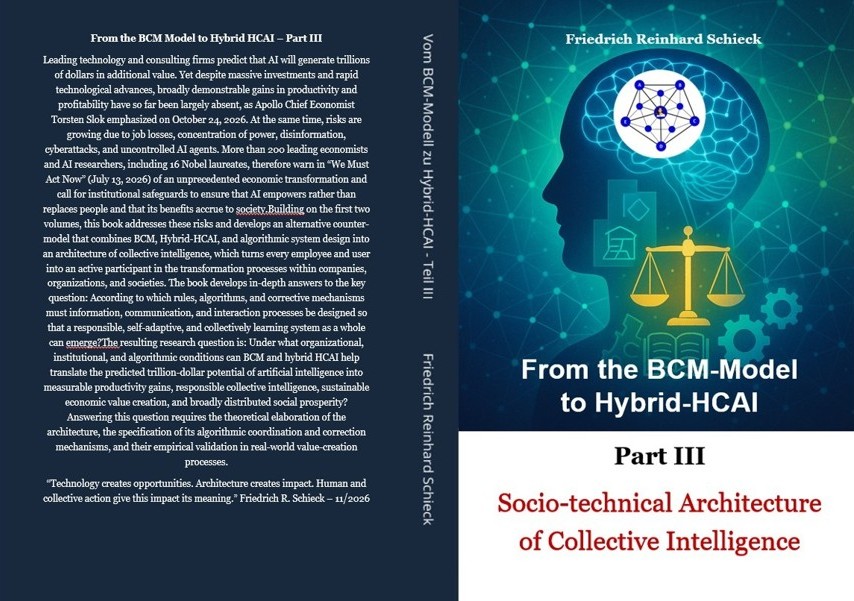
On the Algorithmic Design of Accountable, Self-Adaptive, and Collectively Learning Human-AI Systems in Business and Society.
Abstract of the central argument of the book of the same name by Friedrich Reinhard Schieck · November 2026
ABSTRACT
1. Current Situation – Artificial Intelligence and Economic Challenges
Current Situation: Leading technology companies and international consulting and auditing firms predict that artificial intelligence will generate additional economic value in the trillions of dollars over the next five to ten years. However, these expectations are countered by a fundamental economic paradox: Despite investments worth billions in AI infrastructure, more powerful AI models, and growing automation capabilities, there has been only limited evidence to date of broad-based increases in productivity and profitability outside the technology sector. Torsten Slok, chief economist at Apollo Global Management, specifically points this out in his analysis dated October 24, 2026.1
Added to this are growing risks stemming from job offshoring, the concentration of economic power, disinformation, cyberattacks, and inadequately controlled AI agents. Against this backdrop, more than 200 leading economists and AI researchers, including 16 Nobel laureates, warn in their July 13, 2026, statement “We Must Act Now” of a potentially unprecedented economic transformation. They call for appropriate economic incentives, institutional structures, and societal safeguards to ensure that AI complements human capabilities rather than merely replacing them, and that its economic benefits reach as many people as possible. 2
2. Challenges and Conceptual Framework of the Third Volume
The central challenge of the AI transformation therefore lies not solely in developing increasingly powerful AI systems, but in designing the processes of information, communication, interaction, and decision-making—both among humans and between humans and AI systems—in such a way that technological possibilities give rise to actual productivity gains, sustainable value creation, and responsible collective intelligence. In this sense, the third volume will not merely continue the work done to date on the BCM model and hybrid HCAI, but will synthesize it into a more comprehensive theory and design architecture for socio-technical systems.
While the first volume deals with the conceptual foundations and the second volume with the translation of hybrid HCAI into an implementation agenda, the third volume should focus on the as-yet-unresolved question of the rules, algorithms, institutional mechanisms, and feedback processes necessary for the emergence of accountable collective intelligence. This fundamentally shifts the perspective: The focus is no longer on the capabilities of individual AI models, the automation of individual work processes, or individual collaboration between humans and AI. Rather, the subject of the investigation is the overall system comprising humans, artificial intelligences, organizations, institutional frameworks, and their interrelationships.
The central thesis to be substantiated and tested in the book is:
Collective intelligence does not arise automatically through the interconnection of individual human and artificial intelligences. It requires an appropriate socio-technical architecture that coordinates the information, communication, and interaction processes among all participating actors according to transparent, adaptive, and institutionally legitimate rules.
Such an architecture must ensure individual autonomy, harness distributed knowledge, resolve conflicts and contradictions, facilitate collaborative learning, and at the same time clearly assign responsibility for decisions. The scholarly contribution of the third volume would thus lie in the development of an integrated architectural and regulatory model based on insights from systems theory, cybernetics, organizational science, economics, computer science, AI research, and governance research. In this context, a distinction must be made between the normative design aspirations of the hybrid HCAI model and its performance capabilities, which still need to be empirically tested.
3. The four interconnected main sections
SECTION I · THE PROBLEM AND THE NEED FOR ACTION
- The risks of transformative AI and the limitations of current regulatory approaches
- Why do the economy and society need a new architecture?
SECTION II · THE ARCHITECTURAL MODEL
- From the BCM Model to Hybrid HCAI as a System of Collective Intelligence
- Which actors, structures, and relationships must be connected?
SECTION III · THE ALGORITHMIC MECHANISMS
- Rules, coordination, feedback, and collective learning
- How does the overall system work—and how does it correct itself?
SECTION IV · SCALABILITY AND ACCOUNTABILITY
- Culturally adaptive, federated, and institutionally accountable systems
- How can the architecture be made sustainable and transferable in the long term?
These four sections form a coherent conceptual foundation for my planned book, “From the BCM Model to Hybrid HCAI—Part III: A Socio-Technical Architecture of Collective Intelligence.” In it, I outline a line of argument that extends from the societal and economic risks of transformative AI, through an alternative architectural model, to the concrete algorithmic design and institutional safeguards for collective intelligence. The central research contribution should emerge in particular from the interplay between Sections II and III. Section IV then examines the conditions under which the developed architecture remains functional even outside of individual companies or organizations.
4. Overarching Research Question
Overarching Research Question: According to which socio-technical architectural principles, rules, algorithms, and institutional corrective mechanisms must information, communication, and interaction processes—both between people and between people and AI systems—be designed so that individual, adaptive systems of action can evolve into a coordinated, accountable, self-adaptive, and collectively learning intelligence for businesses, organizations, and societies?
This research question brings together technical, organizational, economic, and societal requirements. It can be broken down into five sub-problems: the coordination of distributed actors, the processing of heterogeneous information, the algorithmic control of interactions, the assignment of responsibility, and the continuous adaptation of the overall system.
My third volume could thus systematically integrate three distinct but complementary perspectives:
- First: Niklas Luhmann’s theory of social systems. It explains how social systems emerge and reproduce themselves through recursive communication. A key point here is that, according to Luhmann, communication—and not the individual—constitutes the fundamental operation of social systems.
- Second: Heinz von Foerster’s second-order cybernetics. It broadens the analysis to include the observer, the conditions under which the observer gains insight, and the observer’s responsibility. This fundamentally challenges the notion of a completely objective system reality that can be controlled from the outside.
- Third: My BCM/Hybrid HCAI approach. It could translate these theoretical insights into a configurable socio-technical architecture in which human actors, AI systems, explicit rules, and institutional mechanisms interact.
From this, the following scientifically fruitful research question can be derived:
How can self-referential and recursive communication systems, as defined by Luhmann, as well as observer-dependent and self-organizing systems, as defined by Heinz von Foerster, be integrated into an algorithmically supported, human-centered, and institutionally accountable hybrid HCAI architecture?
Key theoretical and scientific points of reference for the third volume: Heinz von Foerster and Niklas Luhmann, along with Norbert Wiener, W. Ross Ashby, and Ludwig von Bertalanffy. This gives the book a scope that goes well beyond the usual discussion of AI applications and productivity gains.
5. Preliminary Table of Contents
Four main sections · 24 chapters · Prologue, Introduction, Synthesis, and scholarly appendix
FOREWORD AND PROLOGUE
Foreword – From the Guiding Principle to the Architecture of Collective Intelligence
- The developmental trajectory of the three volumes: the BCM model, Hybrid-HCAI, and algorithmic system design
- What the first two volumes have laid the groundwork for, both theoretically and practically
- Why designing individual human-AI workstations alone is not enough
- The aim of the third volume: From the intelligent individual to a responsible collective system as a whole
Prologue – The Future of AI Is a Matter of Societal System Architecture
- The New Dynamics of Artificial Intelligence and Its Impact on the Economy, Work, and Society
- The “We Must Act Now” Declaration as an Expression of a Growing Scientific Need for Action
- From the Automation of Human Activities to the Redesign of Social Systems
- Why Technical Intelligence Is Not Equivalent to Collective Intelligence
- The Guiding Principle: Humans as Self-Determined Actors in Socio-Technical Transformation Processes
Introduction – Research Subject, Research Objectives, and Scientific Methodology
- Initial Context and Central Problem Statement
- Research Question and Sub-Questions
- Definitions: BCM, Hybrid-HCAI, socio-technical architecture, collective intelligence, and self-adaptivity
- Interdisciplinary foundations and distinction from existing concepts
- Research approach: conceptual model development, design science, simulation, and empirical evaluation
- Structure and logical framework of the book
SECTION I – TRANSFORMATIVE AI AND THE NEED FOR A NEW SOCIO-TECHNICAL ORDER
The Economic, Social, and Institutional Challenges of Artificial Intelligence
1. Chapter – “We Must Act Now”: The Warning About the Consequences of Transformative AI
- The Scientific Statement of July 13, 2026: Origins, Signatories, and Key Messages
- Transformative AI as a Potential Economic Disruption
- Productivity Gains, Job Displacement, and Distributional Effects
- The Danger of a Concentration of Economic and Technological Power
- The Growing Discrepancy Between Technological Progress and Institutional Adaptation
- Why Economic Incentives, Protective Mechanisms, and New Institutions Are Necessary
- From the Scientific Warning to the Question of a Responsible Regulatory Framework
2. Chapter – The Limits of Current AI and Digitalization Strategies
- Technological Progress and the Productivity Paradox
- The Adaptation Gap Between Technical Innovation and Organizational Capacity for Change
- Why Isolated AI Applications Do Not Guarantee Systemic Productivity
- The Fragmentation of Information, Communication, and Collaboration
- Centralized Platforms, Algorithmic Dependencies, and Limited Autonomy of Action
- AI as a Rationalization Tool or as an Extension of Human Capabilities
- The Need for a Fundamental Shift in Perspective
3. Chapter – Information, Communication, and Interaction Processes as the Foundations of Social Systems
- Information as a Prerequisite for Orientation, Coordination, and Agency
- Communication as a Mechanism for Social Understanding and the Formation of Expectations
- Interaction as the Link Between Individual Action and Collective Behavior
- Feedback, Self-Organization, and the Emergence of System Properties
- The Significance of Information and Communication Technologies for the Historical Development of Social Systems
- From the Automation of Information Processing to the Algorithmic Mediation of Social Processes
- Limits of Technical Control and the Internal Logic of Social Systems
- First- and Second-Order Cybernetics: From the Observed to the Observing System
4. Chapter – The Scientific Foundations of Collective Intelligence
- Individual, Organizational, and Collective Intelligence: Conceptual Distinctions
- Collective Intelligence Between Knowledge Aggregation, Coordination, and Collaborative Problem Solving
- Distributed Knowledge, Heterogeneity, and the Importance of Different Perspectives
- Emergence, Network Effects, and Cooperative Learning Processes
- Swarm Intelligence, Collective Intelligence, and Institutionalized Collaboration
- Human Intelligence, Machine Intelligence, and Hybrid Forms of Collective Problem Solving
- Self-organization, Recursion, and the Emergence of Collective Order
- Conditions and Limits of the Emergence of Accountable Collective Intelligence
5. Chapter – Requirements for a New Human-AI System Architecture
- Human Self-Determination and Individual Autonomy of Action
- Transparency, Explainability, and Traceability of Algorithmic Processes
- Cooperation, Trust, and Institutional Accountability
- Adaptability and Collective Learning
- Federated Structures and Decentralized Decision-Making Authority
- Productivity, Innovation Capacity, and Fair Distribution of Value Creation
- Derivation of a Scientific Requirements Catalog for Hybrid HCAI
SECTION II – FROM THE BCM MODEL TO HYBRID-HCAI AS AN ARCHITECTURE OF COLLECTIVE INTELLIGENCE
The integration of people, technology, organizations, and institutions into a single adaptive system
6. Chapter – The BCM Model as a Conceptual Starting Point
- Origins, Objectives, and Development of the BCM Model
- Basic Assumptions and Design Principles of the BCM Approach
- Information, Communication, and Interaction Processes as the Focus of System Design
- Organizational Structures, Work Processes, and Individual Competencies
- Value Creation, Productivity, and Adaptability
- The Evolution from the BCM Model to Hybrid-HCAI
- Unresolved Questions Remaining from the First Two Volumes
7. Chapter – Hybrid-HCAI: From Individual Human-AI Collaboration to a Comprehensive Socio-Technical System
- Human-Centered AI and the Role of Humans in AI-Supported Work Processes
- Subsymbolic, Symbolic, and Human Intelligence as Complementary Components
- The Adaptive Digital Workplace as an Individual Node of Action
- Context-Aware Information Provision and Personalized AI Support
- Human Decision-Making Authority, Rights of Intervention, and Responsibility
- From Individually Intelligent Workplaces to Organization-Wide Networking
- Why Connecting Individual Systems Requires Additional Coordination Mechanisms
8. Chapter – The Structural Architecture of a Federated Hybrid HCAI System
- The Actor Level: Humans, AI Assistants, and Institutional Decision-Makers
- The Information Level: Data, Knowledge, Context, and Semantic Relationships
- The Interaction Level: Communication, Cooperation, and Coordinated Task Execution
- The Algorithmic Level: Rules, Models, and Coordination Procedures
- The Institutional Level: Decision-Making Authority, Responsibilities, and Accountability Structures
- The Federated Connection of Decentralized Units
- Architectural Principles for Interoperability, Extensibility, and Organizational Sovereignty
9. Chapter – LLMs, Generative AI, and Hybrid Intelligence as Technological Components
- Large Language Models and Generative AI: Significance, Possibilities, and Limitations
- Subsymbolic Pattern Recognition and Context-Aware Information Processing
- Symbolic Knowledge Representation, Explicit Rules, and Verifiable Inferences
- Neurosymbolic AI and the Integration of Different Forms of Processing
- Retrieval-Augmented Generation, Knowledge Graphs, and Context-Aware Information Provision
- AI Agents and Multi-Agent Systems as Components of Distributed Work Architectures
- Why LLMs Alone Do Not Create Institutionally Accountable Collective Intelligence
10. Chapter – The Adaptive Digital Workplace as the Starting Point for Collective Intelligence
- The Employee and User as an Independent Actor
- Personal AI Assistants and Individually Configurable Work Environments
- Role-, Task-, and Situation-Based Context Models
- Information Autonomy, Access Rights, and Data Sovereignty
- Human-AI Collaboration as a Continuous Learning and Adaptation Process
- The Interconnection of Individual Workplaces Through Regulated Communication Relationships
- The Transition from Individual Competence Enhancement to Collective Performance
11. Chapter – From a Network of Individual Actors to a Coordinated, Intelligent Overall System
- The Organization as a Network of Human and Artificial Actors
- Horizontal, Vertical, and Cross-Organizational Relationships
- Joint Goal Setting and Coordinated Expectations for Action
- Distributed problem-solving and collective decision support
- Balancing individual autonomy and shared interests
- Emergence, coherence, and stability in complex human-AI systems
- Requirements for a comprehensive algorithmic coordination architecture
SECTION III – THE ALGORITHMIC FOUNDATIONS OF RESPONSIBLE COLLECTIVE INTELLIGENCE
Rules, algorithms, and correction mechanisms for the design of information, communication, and interaction processes
12. Chapter – From System Architecture to Algorithmic Design
- Why Technical Interconnection Does Not Guarantee Coordinated Collaboration
- The Difference Between Algorithmic Computation and Socio-Technical Coordination
- Mapping Goals, Roles, Rights, and Responsibilities into Formal Rules
- The Integration of Probabilistic AI Models with Explicit Decision and Procedural Rules
- Local Autonomy and Overarching System Coherence
- The Distinction Between Operational, Coordinating, and Institutional Control Mechanisms
- The Observer as a Participant: Consequences of Second-Order Cybernetics for Algorithmic Coordination.
- Requirements for an Integrated Algorithmic Control Model
13. Chapter – Algorithms for Information Processing and Knowledge Coordination
- Information Relevance, Contextual Reference, and Semantic Understanding
- Dynamic Context Models and Distributed Knowledge Representation
- Semantic Mapping, Knowledge Integration, and Contradiction Detection
- Information Quality, Uncertainty, Proof of Origin, and Trustworthiness
- Personalized Information Provision Without Systemic Information Bias
- Methods for Updating, Correcting, and Sharing Knowledge
- From Individual Knowledge Bases to an Adaptive Collective Knowledge System
14. Chapter – Algorithms of Communication and Cooperative Understanding
- Communication as a Rule-Based Exchange Between Autonomous Actors
- Communication Protocols for Human-to-Human and Human-to-AI Relationships
- Roles, Communication Rights, and Context-Dependent Information Sharing
- Dialogue, Negotiation, and Consensus-Building Procedures
- Dealing with Ambiguity, Disagreements, and Contradictory Information
- Trust, Reputation, and the Limits of Algorithmic Trust Assessments
- Communication Rules as Prerequisites for Collective Coordination
15. Chapter – Algorithms of Interaction and Distributed Action Coordination
- Interaction as the Integration of Communication, Decision-Making, and Action
- Distributed Task Planning and Decentralized Resource Coordination
- Role-Based Authorization and Delegated AI Functions
- Coordination Protocols for Human Actors and AI Agents
- Conflicts of Interest, Prioritization, and Rule-Based Conflict Resolution
- Synchronizing Local Decisions with Shared System Goals
- Limits of Algorithmic Control in Open, Dynamic Social Processes
16. Chapter – Self-Adaptivity, Feedback, and Collective Learning Capacity
- Self-Adaptivity as a Property of Socio-Technical Systems as a Whole
- Observation, Evaluation, Adaptation, and Learning as Control Loops
- Individual Learning Processes and Their Translation into Organization-Wide Experiences
- Explicit Feedback, Implicit Feedback, and the Limits of Their Interpretation
- Continuous Improvement of Rules, Models, and Coordination Procedures
- Stability, Adaptability, and Protection Against Undesirable Self-Perpetuating Dynamics
- Recursive Observation, Evaluation, and Adaptation Processes in Hybrid Human-AI Systems.
- The Architecture of a Collectively Adaptive Hybrid HCAI System
17. Chapter – Responsibility, Algorithmic Correction, and Human Final Decision-Making
- Why Self-Adaptive Systems Need Verifiable Boundaries
- Von Foerster’s Ethical Imperative as a Normative Point of Reference for Human Self-Determination.
- Institutional Decision-Making Authority and Formal Attribution of Responsibility
- Human Options for Intervention, Objection, and Correction
- Traceability of Information Flows, Rule Applications, and Decisions
- Error Detection, Anomaly Checking, and Escalation Mechanisms
- Conflicting Goals Between Efficiency, Fairness, Self-Determination, and Security
- Development of a Multi-Level Correction and Accountability Model
18. Chapter – The Integrated Algorithmic Hybrid HCAI Reference Model
- Integration of Information, Communication, and Interaction Algorithms
- The Interplay of Sub-symbolic, Symbolic, and Institutional Control
- Formal Description of Actors, States, Relationships, and Rules
- Event-Driven Processes and Adaptive Coordination Mechanisms
- Multi-Level Feedback and Correction Loops
- Reference Scenarios for Collective Problem Solving and Organizational Learning
- Hypotheses, Success Criteria, and Limitations of the Proposed Architecture
SECTION IV – CULTURALLY ADAPTIVE, FEDERATED, AND INSTITUTIONALLY ACCOUNTABLE COLLECTIVE INTELLIGENCE
19. Chapter – Cultural Adaptability and Trust in Human-AI Systems
- Organizational Culture as a Framework for Socio-Technical Collaboration
- Cultural Differences in Communication, Cooperation, and Decision-Making
- Context-Dependent Adaptation of Interaction and Coordination Rules
- Trust Among People and Between People and AI Systems
- Participation, Acceptance, and Co-Design of Algorithmic Systems
- Cultural Adaptability Without Compromising Fundamental Rights
- Design Principles for a Culturally Adaptive Hybrid HCAI Architecture
20. Chapter – Federation, Scaling, and Cross-Organizational Cooperation
- From Individual Workgroups to Enterprise-Wide Architecture
- Scaling Across Departments, Locations, and Organizational Boundaries
- Federated Data, Knowledge, and Decision-Making Structures
- Interoperability Between Different Technical and Institutional Systems
- Coordination Without Complete Centralization
- Transferability Across Organization Sizes and Industries
- Architectural Principles of a Federated Collective Intelligence
21. Chapter – Governance, Democratic Participation, and Institutional Accountability
- Governance as an Integral Part of System Architecture
- Rights, Duties, and Responsibilities of Human and Institutional Actors
- Participatory Processes for Defining Algorithmic Rules
- Control, Audit, and Complaint Mechanisms
- Data Protection, Non-Discrimination, and Rule-of-Law Requirements
- Linking Technical Frameworks with Institutional Legitimacy
- Federated Governance as an Alternative to Centralized Algorithmic Exercise of Power
22. Chapter – Productivity, Value Creation, and Collective Innovation Capacity
- From Individual AI Productivity to Systemic Value Creation
- The Economic Significance of Cooperative Human-AI Systems
- Innovative Capacity Through Distributed Knowledge and Coordinated Learning Processes
- Changes in Tasks, Roles, and Skill Requirements
- The Distribution of Productivity Gains and Stakeholder Participation
- Economic Performance Indicators and Societal Impacts
- Conditions for Sustainable Value Creation and Growth Processes
23. Chapter – Implementation, Simulation, and Empirical Validation
- Procedural Model for the Introduction of a Hybrid HCAI Architecture
- Mapping of Existing Information, Communication, and Interaction Structures
- Selection of Suitable Organizational Application Scenarios
- Modeling and Simulation of Stakeholder Relationships and Control Mechanisms
- Prototype Implementation and Experimental Testing
- Measurement of Coordination Quality, Productivity, Trust, and Learning Ability
- Comparison with Alternative Organizational and AI Architectures
24. Chapter – Perspectives on a Socio-Technical Architecture of Collective Intelligence for Society
- From Enterprise Architectures to Societal Cooperation Systems
- Human-AI Collaboration in Administration, Education, Research, and Public Infrastructure
- Societal Knowledge Integration and Institutional Coordination Capacity
- Democratic Self-Determination and Social Participation in the AI Era
- The Possibilities and Limits of Federated Collective Intelligence
- Open Research Questions and Long-Term Development Perspectives
- From Technical AI Transformation to the Responsible Shaping of Social Value Creation
CONCLUSION AND SCIENTIFIC APPENDIX
Synthesis – From Individual Intelligence to Responsible Collective Agency
- Synthesis of the findings from the four sections
- Answer to the overarching research question
- The key architectural principles of the proposed hybrid HCAI model
- Scientific contribution and differentiation from existing approaches
- Limitations of the model, open questions, and areas for further research
6. The book’s central thesis
The current AI growth forecasts and the “We Must Act Now” declaration highlight two sides of the same economic transformation: While AI holds extraordinary technological and economic potential, its widespread realization is by no means guaranteed. In particular, the limited macroeconomic impact on productivity, organizational adaptation deficits, and increasing security and societal risks show that technological innovation alone is not a sufficient prerequisite for economic and societal progress.
BCM and Hybrid-HCAI could serve as an integrated socio-technical value-creation architecture in this context: Through the adaptive, federated, and rule-based integration of human and artificial intelligence, individual AI applications are intended to give rise to coordinated information, communication, interaction, and decision-making processes that combine productivity, innovation capacity, organizational learning, and social responsibility. This shifts the focus of AI transformation from the mere development of more powerful machines to the design of intelligent, adaptive, and accountable socio-technical systems as a whole.
The resulting research question is: Under what organizational, institutional, and algorithmic conditions can BCM and hybrid HCAI help translate the predicted trillion-dollar potential of artificial intelligence into measurable productivity gains, accountable collective intelligence, sustainable economic value creation, and broadly distributed societal prosperity? Answering this question requires the theoretical elaboration of the architecture, the specification of its algorithmic coordination and correction mechanisms, and their empirical validation in real-world value-creation processes.
“Technology creates opportunities. Architecture creates impact. Human and collective action gives this impact its meaning.” Friedrich Reinhard Schieck – 11/2026
Keywords: Business Communication Management (BCM); Hybrid Human-Centered AI; Hybrid-HCAI; Federated Neuro-Symbolic AI; Collective Intelligence; Information Distribution; Communication and Interaction Rules; Algorithmic Coordination; Adaptive Digital Workplace; Participatory AI Governance; Human Decision Sovereignty; Institutional Responsibility; Normative, Structural and Processual Culture; Cultural Adaptivity; Recursive Self-Adaptation; Federated Sovereignty; Collective Learning; Qualitative Scaling; Adaptation Gap; Adaptation Latency; Systemic Productivity; Responsible Value Creation; Socio-Technical Systems Architecture, Productive Value Creation, AI-Transformation, Role-based self-organization
The book “From the BCM Model to Hybrid HCAI—Part III” will be available on Amazon via the link in the book series of the same name: https://www.amazon.com/dp/B0HKF3HTBQ;
A 3-book series: https://www.amazon.com/-/de/dp/B0HPGYS9S4?binding=kindle_edition&ref=dbs_dp_sirpi
Quellen:
Torsten Slok – Partner, Chief Economist – October 24, 2026 – “No Signs of AI Payoff Outside the Tech Sector”, https://www.apollo.com/institutional/insights-news/insights/daily-spark/no-signs-of-ai-payoff-outside-the-tech-sector?utm_source=chatgpt.com
“We Must Act Now” – 13. Juli 2026 – Sechzehn Nobelpreisträger schließen sich führenden Ökonomen und KI-Forschern an – Stanford Digital Economy Lab, https://www.wemustactnow.ai/; https://digitaleconomy.stanford.edu/news/wemustactnow/
The book “From the BCM Model to Hybrid HCAI – Part I” is available on Amazon via the following link: https://www.amazon.com/dp/B0HNHQVNNY
The book “From the BCM Model to Hybrid HCAI – Part II” is available on Amazon via the following link: https://www.amazon.com/dp/B0HMXXXF87
Schieck, Friedrich R. (2023): „Wo liegt der Fehler im System der Digitalen Transformation…?“, https://friedrichschieck.substack.com/p/where-is-the-fault-in-the-system
Schieck, Friedrich R. (2024): „Wann wird KI zur Killerapplikation für Produktivitätswachstum und Bürokratieabbau in Unternehmen?“, https://friedrichschieck.substack.com/p/when-will-ai-become-the-killer-application
Schieck, Friedrich Reinhard (2025): „From the BCM Model to Hybrid HCAI – Part I“. Journal of Strategic Innovation and Sustainability, https://friedrichschieck.substack.com/p/from-the-bcm-model-to-hybrid-hcai
Schieck, Friedrich R. (2026): „Der individualisierte und adaptive digitale Arbeitsplatz als zentraler Anwendungsfall für eine hybride HCAI-Plattform“, https://friedrichschieck.substack.com/p/the-personalized-digital-workplace
Schieck, Friedrich R. (2026): „Hybrid-HCAI: Der Heilige Gral der KI oder der nächste Schritt verantwortbarer Wertschöpfung?“, https://friedrichschieck.substack.com/p/hybrid-hcai-the-holy-grail-of-ai
Schieck, Friedrich R. (2026): „Von BCM zu föderierter neuro-symbolischer Hybrid-HCAI“, https://friedrichschieck.substack.com/p/from-bcm-to-federated-neuro-symbolic
Schieck, Friedrich Reinhard (2026): “From the Concept of Humanity to the Economics of Social Systems and the Architecture of Collective Intelligence”; https://friedrichschieck.substack.com/p/from-the-concept-of-humanity-to-the
© 2026 Friedrich R. Schieck – BCM Consult
- eMail: friedrich@schieck.org; fs@bcmconsult.com;
- Website: https://bcmconsult.com/en/blog/
- Academia: https://independent.academia.edu/FriedrichSchieck
- LinkedIn: https://www.linkedin.com/in/friedrichschieck
- Substack: https://friedrichschieck.substack.com/
- Twitter/X: https://x.com/FSchieck